
By Luke Fletcher | Atlanta, Georgia
The room wasn’t filled with coaches debating fourth-down decisions or athletic directors arguing over playoff formats.
Instead, some of the most powerful figures in college athletics gathered around a different issue entirely.
Conference commissioners. University presidents. Congressional staff members. Television executives. The conversation centered on a proposal that, at first glance, seemed almost insignificant.
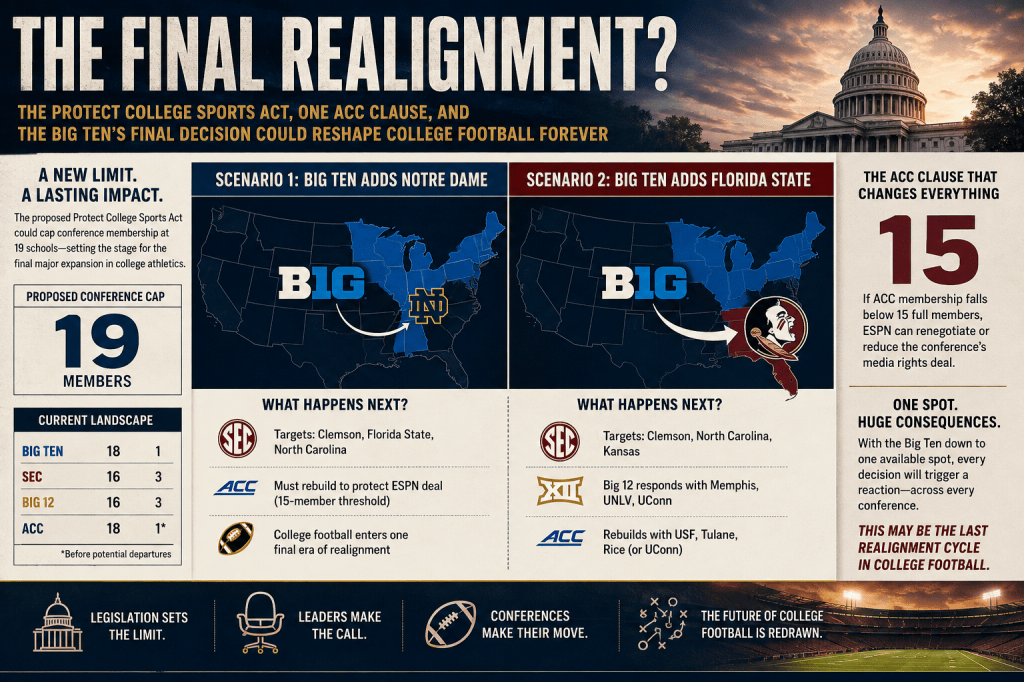
What if conferences could have no more than 19 members?
To the casual fan, it sounded like an arbitrary number. To the people in the room, it represented something far bigger. It could become the final line on the map of college football.
For nearly two decades, conference realignment has been driven by an endless pursuit of television revenue. Every media rights negotiation created another round of expansion. Every expansion shifted recruiting, rivalries, playoff access, and billions of dollars in future revenue.
But a 19-school cap changes the equation. Instead of asking, “Who can we add next?”
Conference leaders suddenly have to ask, “Who gets the last invitation?”
That single question may determine the future of every major conference in America.
No conference understands that better than the Big Ten. Does it finally land its long-coveted prize in Notre Dame?
Or does it decide the future is more valuable than tradition and extend its final invitation to Florida State, planting its flag in one of the nation’s richest recruiting territories?
The answer won’t simply reshape the Big Ten.
It will ripple through the SEC, the ACC, the Big 12, and perhaps every level of major college football. Long before Congress began discussing conference size, one university had already become the face of college athletics’ financial divide.
Florida State.
On August 24, 2024, Florida State walked into Dublin, Ireland, as the preseason favorite to win the Atlantic Coast Conference. Thousands of Seminole fans packed Aviva Stadium expecting another championship run. Instead, Georgia Tech stunned the Seminoles 24–21, delivering one of the opening weekend’s biggest upsets.
It was an unexpected loss. But in hindsight, it almost felt symbolic. For years, Florida State’s battle with the ACC had never really been about football.
It was about economics. It was about television. It was about a growing belief among college athletics’ biggest brands that the future belonged to the conferences capable of generating the largest media rights contracts.
That fight eventually led to lawsuits, settlement negotiations, and a revised exit structure that finally gave Florida State—and eventually Clemson—a clearer path toward leaving the conference.
Now another force may fundamentally reshape the future of conference realignment. It isn’t another television contract. It isn’t another university president.
It isn’t even another conference commissioner. It’s Congress. And if lawmakers ultimately approve a proposal limiting conference membership to 19 schools, the next round of realignment may not simply be another chapter in college football history.
It may be the last one.
The Billion-Dollar Business Behind Saturdays
There was a time when conference realignment was about geography. The Big Eight belonged to the Plains. The Pac-10 represented the West Coast. The SEC was firmly rooted in the Deep South.
Those days are gone.
Today’s conferences are media companies. Football Saturdays remain the product. Television inventory is the business. Every major expansion decision over the past fifteen years has been driven by one simple question.
Will adding this university increase the value of the next television contract?
That question sent:
- Nebraska to the Big Ten.
- Texas A&M and Missouri to the SEC.
- Maryland and Rutgers east.
- Oklahoma and Texas into the SEC.
- USC, UCLA, Oregon and Washington into the Big Ten.
- Stanford, California and SMU into the ACC.
Tradition mattered. Academics mattered. Geography mattered. But television revenue mattered most. The next phase of realignment appears destined to follow the same script.
Congress May Have Created the Endgame
The proposed Protect College Sports Act has generated headlines for its efforts to establish national standards surrounding NIL, revenue sharing, athlete protections and governance.
Less discussed, but potentially just as important, is a proposal that would place a 19-school membership cap on conferences. While the legislation continues to evolve and has not yet become law, the concept has sparked enormous discussion across college athletics.
If conferences are eventually limited to nineteen members, expansion doesn’t disappear. It becomes scarce. Instead of conferences endlessly chasing twenty-two or twenty-four members, every remaining invitation suddenly becomes one of the most valuable assets in college sports.
The conversation changes from:
“How big can we become?”
to
“Who deserves one of the last available seats?”
Why Nineteen?
At first glance, nineteen seems like an unusual number. Why not freeze conferences at eighteen? Or allow twenty?
The answer may be strategic; Rather than locking conferences exactly where they stand today, a 19-school cap would provide each league with one final opportunity to position itself before expansion ends.
Today’s landscape would look like this.
| Conference | Current Members | Remaining Spots |
|---|---|---|
| Big Ten | 18 | 1 |
| SEC | 16 | 3 |
| Big 12 | 16 | 3 |
| ACC | 18 (17 fb mbrs) | 1 (before any departures) |
That creates a fascinating dynamic: The Big Ten has one move left; the SEC has three; the Big 12 has flexibility, and the ACC has stability, for now.
But that stability may prove more fragile than it appears.
The Big Ten’s Final Seat Isn’t Just About Notre Dame
The easy assumption is that the Big Ten’s nineteenth member has already been decided.
Notre Dame.
After all, the Fighting Irish check nearly every imaginable box.
- One of the nation’s most recognizable brands.
- Historic rivalries with Michigan, Michigan State and Purdue.
- Existing television relationship with NBC.
- Elite academics.
- National fan base.
- Consistently strong television ratings.
If Notre Dame ever decides football independence no longer serves its long-term interests, the Big Ten would almost certainly welcome the Irish immediately.
But that doesn’t necessarily mean the nineteenth spot exists solely for Notre Dame. In fact, the proposed cap may simply provide the conference with one final strategic decision.
If Notre Dame remains independent, as it has for more than a century, the Big Ten’s attention could quickly shift elsewhere. No one school stands above the rest.
Florida State.
At first glance, adding another football powerhouse seems obvious. The deeper value, however, isn’t just wins and losses.
- It’s geography.
- It’s recruiting.
- It’s television.
The Big Ten has spent the last decade expanding into Los Angeles, Seattle, Portland and Washington, D.C.
One major growth market remains absent. Florida!!
Adding Florida State would immediately place the Big Ten inside one of America’s fastest-growing states while giving FOX, CBS and NBC another premier football brand capable of delivering national audiences.
The Seminoles would also provide direct access to one of college football’s richest recruiting territories.
Unlike Notre Dame, Florida State expands the conference into an entirely new geographic region while strengthening its football inventory.
The decision ultimately becomes philosophical. Notre Dame offers unmatched history, prestige and national appeal. Florida State offers future growth, recruiting dominance and access to one of the country’s most valuable states.
Rather than reserving the nineteenth spot for one specific university, the proposed legislation may simply allow the Big Ten to make one final strategic choice before expansion comes to an end. That single decision could reshape every conference in America.
The Clause Almost Nobody Talks About
While the Big Ten debates its final invitation, the ACC faces an entirely different challenge. Hidden inside the conference’s ESPN television agreement is one of the most important numbers in college athletics.
Fifteen. Today the ACC consists of 17 full members after adding Stanford, California and SMU. Notre Dame is a partial, non-football member of the Atlantic Coast Conference (ACC), meaning all of its varsity sports compete in the ACC except for football (which remains independent) and ice hockey (which competes in Big Ten/Hockey East)
That means the conference currently sits two schools above a critical contractual threshold. If ACC membership ever falls below fifteen full members, ESPN gains the contractual ability to renegotiate or reduce the financial terms of the conference’s media agreement.
The ACC is not legally required to replace departing schools. Financially, however, it almost certainly must.
Lose one member, No problem. Lose two, still manageable. Lose three , and the conference falls to fiftee, standing directly on the contractual line. Lose a fourth, and the economics of the league could change overnight.
That reality makes Jim Phillips’ job fundamentally different from Greg Sankey’s or Tony Petitti’s. The SEC and Big Ten expand because they want to. The ACC may soon expand for a second time because it has to.
Sixteen or Eighteen?
That single ESPN clause creates two very different expansion philosophies. The first is conservative. If the ACC loses two schools, Commissioner Jim Phillips could simply add one carefully selected institution, returning the conference to 16 members, plus Notre Dame.
That approach keeps the league above the contractual threshold while preserving flexibility if another round of realignment develops.
The second is aggressive. Rather than stopping at sixteen, the ACC could immediately rebuild to 18 football playing members, plus Notre Dame, plussing up from its current size while creating another buffer against future departures.
The decision won’t simply depend on who becomes available. It will depend on whether conference leadership believes the next media rights cycle represents another chapter in college football, or the final one.
Every Domino Depends on One Decision
Perhaps the most fascinating aspect of the next expansion cycle is how interconnected every conference has become. The Big Ten’s final invitation doesn’t simply affect the Big Ten. It determines who becomes available to the SEC.
The SEC’s decisions reshape the ACC. The ACC’s response could trigger movement throughout the American Athletic Conference and beyond.
The Big 12 may only expand if the SEC decides one of its flagship institutions belongs in the nation’s premier football conference
Every move depends on the one before it. For the first time in decades, the future of college football may hinge on a single invitation.
Does Notre Dame choose the BigTen, preserving the ACC’s biggest football brands for another fight?
Or does it choose Florida State, setting off the largest wave of conference realignment since the collapse of the Pac-12? The answer to that question doesn’t just determine the Big Ten’s future. It may determine the future of every major conference in America.
How One Decision Could Trigger the SEC’s Biggest Expansion Since Texas and Oklahoma
There is a reason every conversation about conference realignment eventually circles back to Notre Dame. The Fighting Irish are college football’s last true independent power.
For decades, Notre Dame has occupied a unique place in the sport. While every other national brand aligned itself with a conference, the Irish remained independent, protected by tradition, a national fan base, and an exclusive television partnership with NBC.
But if Congress ultimately limits conferences to 19 members, the calculus changes. Suddenly, independence comes with a cost. The Big Ten would have one final invitation. The SEC would still have three.
If Notre Dame believes conference membership is inevitable someday, waiting too long could mean watching the last seat disappear. For that reason, many athletic directors and television executives believe Notre Dame remains the Big Ten’s preferred outcome. If that happens, the ripple effects across college athletics would be immediate.
IF The Big Ten Gets Its White Whale
For nearly 100 years, the Big Ten has admired Notre Dame from afar. The fit has always been obvious. Academically, Notre Dame aligns with the conference’s institutional profile.
Athletically, the Irish already compete annually against multiple Big Ten opponents. Financially, Notre Dame consistently ranks among the nation’s most valuable television brands.
From the Big Ten’s perspective, no other available university combines:
- National brand recognition.
- Historic football success.
- Strong national television ratings.
- Elite academics.
- Existing rivalries.
- Alumni spread across every major media market.
Simply put, there is only one Notre Dame. If the Irish finally say yes, Commissioner Tony Petitti doesn’t hesitate. The Big Ten closes expansion at 19 members. Attention immediately shifts south.
The SEC Suddenly Controls the Board
With Notre Dame off the table and Florida State still in the ACC, the SEC becomes college football’s kingmaker. Commissioner Greg Sankey would possess something every other conference lacks:
Three available invitations.
Those invitations become incredibly valuable because expansion inside the SEC has never been about simply adding schools. It has always been about increasing the value of the next ESPN media rights agreement.
Texas and Oklahoma weren’t invited because they were successful. They were invited because they increased the value of every SEC television window. The next three invitations would be evaluated exactly the same way.
Target No. 1: Clemson
If there is one school that feels like it has been preparing for SEC membership without officially saying so, it’s Clemson. Everything about the Tigers resembles an SEC institution.
Their recruiting footprint overlaps almost perfectly with the conference. Their fan support rivals nearly every current member.
Their football success speaks for itself. Since 2015, Clemson has become one of the defining programs of modern college football, winning multiple national championships while producing NFL talent at nearly every position.
Just as importantly, Clemson creates television inventory.
Games against:
- Georgia
- South Carolina
- Alabama
- LSU
- Florida
- Auburn
would instantly become premier television events. From ESPN’s perspective, Clemson isn’t simply another member. It’s premium programming. If Florida State remains unavailable, Clemson becomes the easiest decision on the board.
Target No. 2: Florida State
Florida State has spent years making one point abundantly clear. The Seminoles believe they belong in a conference capable of generating SEC or Big Ten revenue.
If Notre Dame joins the Big Ten, that leaves Florida State staring at two choices. Remain in the ACC or accept an SEC invitation. From a football perspective, the fit is almost perfect. The SEC already recruits Florida heavily.
Adding Florida State strengthens the conference’s position in one of the nation’s richest recruiting territories while adding another blue-blood football brand.
The Seminoles provide:
- National championships.
- Elite recruiting.
- Massive television audiences.
- Strong alumni support.
- One of the country’s premier game-day atmospheres.
Some argue the SEC already owns Florida through the Gators. History suggests otherwise. The SEC has never hesitated to add multiple schools within the same state if the television value justified the move.
Texas already demonstrates that philosophy. Florida State would become another flagship property for SEC TV.
Target No. 3: North Carolina
This is where football fans and television executives begin viewing expansion differently. Ask fans who the SEC should add and many immediately answer Miami, Virginia Tech, or Louisville.
Those schools make football sense. North Carolina makes media sense.
The Tar Heels deliver something every conference covets. Growth, and North Carolina is one of America’s fastest-growing states.
The Raleigh-Durham and Charlotte markets continue expanding. The university carries enormous academic prestige. Basketball remains one of the nation’s premier television properties. While football continues investing heavily under modern leadership, adding North Carolina isn’t simply about Saturdays.
It’s about creating valuable television inventory every month of the year. That matters during media negotiations.
The Schools Left Waiting
Not making the SEC’s first three does not mean a school lacks value. It simply means another institution creates more. Virginia likely becomes the conference’s fourth option.
The Cavaliers offer:
- AAU membership.
- Access to the Washington, D.C. region.
- Strong academics.
- Institutional prestige.
If the SEC prioritizes research partnerships and Mid-Atlantic growth over basketball inventory, Virginia could certainly move ahead of North Carolina or even Florida State.
Oklahoma State would also receive consideration. The Cowboys remain one of the nation’s most consistent football programs. The problem is geography. Adding Oklahoma State expands very little after Oklahoma already joined the conference.
TCU faces a similar challenge. Dallas-Fort Worth is one of America’s largest markets.
But Texas and Texas A&M already provide the SEC tremendous exposure throughout the state. Both remain excellent institutions. Neither dramatically changes ESPN’s business model.
Why the ACC Faces Its Biggest Moment
If Clemson, Florida State and North Carolina all depart, the ACC immediately drops from 18 members to 15. That number matters, not because fifteen is unworkable.
Because fifteen is the line inside the conference’s ESPN agreement. Fall below it and the network gains the ability to revisit the financial structure of the contract.
That changes everything and Jim Phillips wouldn’t simply be replacing schools. He’d be protecting the conference’s future revenue.
Scenario A: Protect the Contract at 16
The most conservative response would be to quickly add one institution. Doing so immediately moves the ACC above the contractual threshold while preserving flexibility for another expansion cycle. If that becomes the strategy, one school stands above the rest.
South Florida
The Bulls have quietly positioned themselves as one of the country’s fastest-rising athletic departments. USF offers:
- Tampa-St. Petersburg television market.
- AAU membership.
- One of America’s largest enrollments.
- A new on-campus football stadium.
- Outstanding recruiting territory.
TULANE
Tulane as few schools fit the ACC’s academic profile better. The Green Wave provide:
- AAU membership.
- New Orleans television market.
- Strong football momentum.
- Elite academics.
Most importantly, USF and Tulane restores the ACC to sixteen members, and the television contract remains protected. The ACC waits to see what happens next.
Scenario B: Build to 17 or grow to18
The more aggressive approach is also the more ambitious one.
Rather than stopping at sixteen, the ACC could immediately restore itself to eighteen members. That creates breathing room and it protects against future departures. The final decision becomes the conference’s most interesting. Rice or Connecticut, or both?
Rice vs. UConn, or Both
On paper, Connecticut owns the stronger athletic brand. The Huskies are arguably the greatest basketball program of the last quarter-century. They would instantly become one of the ACC’s premier winter television properties.
Rice, however, offers something Connecticut cannot. America’s fifth-largest media market, in Houtson!
An AAU institution and one of the nation’s premier research universities. Of course a natural travel partner for SMU. If the ACC believes long-term television distribution and institutional alignment outweigh basketball inventory, Rice likely receives the invitation.
If conference presidents instead decide elite basketball content becomes increasingly valuable in the streaming era, Connecticut becomes impossible to ignore. Or they could decide to take both and got to 18 plus Notre Dame. This may ultimately become the ACC’s defining expansion debate, does going to 18 make the most financial sense.
The New ACC
Under the aggressive model, the rebuilt conference could include:
- Boston College
- California
- Duke
- Georgia Tech
- Louisville
- Miami
- NC State
- Pittsburgh
- SMU
- Stanford
- Syracuse
- Virginia
- Virginia Tech
- Wake Forest
- Rice
- Tulane
- USF
- UCONN
It wouldn’t resemble the ACC of old, but it would remain nationally relevant, academically elite, and financially positioned to survive the next decade.
How One Decision Could Redraw the SEC, Force the Big 12 to Reload, and Bring the Era of Conference Realignment to a Close
For nearly a decade, Florida State has been viewed as the conference realignment domino waiting to fall. The Seminoles have publicly challenged the ACC’s revenue distribution, fought the conference in court, and negotiated a clearer path out of the Grant of Rights. Their frustration has never been hidden.
Now imagine the Big Ten makes a different choice. Instead of waiting for Notre Dame to someday abandon independence, Commissioner Tony Petitti decides the future is too valuable to leave open. The Big Ten invites Florida State and the Seminoles say yes.
Notre Dame remains independent. At first glance, it looks like only one school changed conferences.
In reality, it reshapes the strategy of every major league in college athletics.
The Big Ten Bets on the Future
Choosing Florida State over Notre Dame isn’t simply choosing one football program over another. It’s choosing future growth over historical certainty.
Notre Dame remains one of the sport’s biggest brands, but Florida State offers something unique. The Seminoles give the Big Ten access to:
- One of the nation’s fastest-growing states.
- Elite recruiting territory.
- A flagship public university.
- A perennial College Football Playoff contender.
- A major presence in the Southeast.
For FOX, CBS and NBC, Florida State immediately adds premium inventory while expanding the conference’s footprint into a state filled with Big Ten alumni and television viewers.
Would Notre Dame still be attractive? Absolutely. However, if the Fighting Irish remain committed to independence, the Big Ten may decide waiting forever isn’t a strategy.
It may be time to move on.
The SEC Changes Course
Without Florida State available, the SEC’s expansion strategy becomes more interesting. Clemson remains the obvious first call. Nothing changes there. The Tigers still fit everything the conference values: Elite football, recruiting, rivalries, and television ratings, and geographic continuity. Clemson remains the easiest decision on the board.
The second invitation still belongs to North Carolina. The Tar Heels continue offering one of the nation’s fastest-growing states, tremendous academic prestige and premium basketball inventory. The third invitation, however, becomes the most fascinating decision in modern conference realignment.
The Case for Kansas
Mention Kansas as an SEC expansion candidate and many fans immediately laugh. Until they look at the business, the SEC has already proven expansion isn’t simply about football. Texas wasn’t invited because it won championships. Texas was invited because it increased the value of ESPN’s media rights. Kansas brings value in different ways. The Jayhawks offer:
- One of the premier basketball brands in America.
- A loyal national following.
- AAU membership.
- Kansas City television presence.
- An improving football program.
- A completely new geographic footprint.
While football remains the engine driving media rights, college basketball has become increasingly valuable in the streaming era.
March inventory matters, and weeknight inventory matters. Kansas instantly gives ESPN another blue-chip property from November through March while continuing to improve on the football field.
Unlike Oklahoma State or TCU, Kansas also expands the SEC into a region where it currently has little presence. That combination makes the Jayhawks far more intriguing than many realize.
Why Not Virginia?
Virginia remains an outstanding institutional fit. The Cavaliers provide:
- AAU membership.
- Washington, D.C. proximity.
- Academic prestige.
- Strong Olympic sports.
If the SEC’s priority is research partnerships and institutional alignment, Virginia may very well become the favorite. However, if ESPN asks one question:
“Which school increases the value of our overall sports portfolio?” Kansas becomes extremely difficult to ignore.
The SEC’s Final Expansion Board
If Florida State joins the Big Ten, my projection becomes:
- Clemson
- North Carolina
- Kansas
First Four Out:
- Virginia
- Oklahoma State
- TCU
- Virginia Tech
Reasonable people can disagree on the order, but the logic remains consistent. Every invitation must create more media value than it costs.
Kansas Leaves. The Big 12 Responds.
For Brett Yormark, losing Kansas would represent more than losing a member institution. It would mean losing one of college basketball’s defining brands.
The commissioner has spent much of his tenure marketing the Big 12 as America’s deepest basketball conference. Replacing Kansas requires thinking beyond football. Fortunately, there are several candidates who fit that vision.
Target No. 1: Memphis
If one Group of Five program has been waiting for this moment, it’s Memphis. The Tigers provide exactly what the Big 12 would lose. Elite basketball, competitive football, and strong television inventory. Corporate support through FedEx.
A passionate fan base. and a few schools offer a better combination of athletic success and media value. f Kansas leaves, Memphis should receive the first phone call.
Target No. 2: UNLV
Las Vegas has quietly become one of America’s sports capitals. Super Bowls, Formula One, College Football Playoff events, NCAA Tournaments. The city has become one of the country’s premier entertainment destinations.
UNLV gives the Big 12:
- Las Vegas media market.
- Improving football.
- Historic basketball.
- A city capable of hosting conference championships for decades.
The fit aligns perfectly with Brett Yormark’s vision of a national conference built around entertainment and premium inventory.
Target No. 3: San Diego State
San Diego State has quietly become one of the most attractive expansion candidates outside the Power Four.
The Aztecs bring:
- The San Diego media market.
- Consistently competitive football.
- One of the nation’s best recent Group of Five athletic departments.
- Strong basketball tradition with multiple NCAA Tournament appearances.
- Access to Southern California recruiting.
The Big 12 has already demonstrated a willingness to expand west with Arizona, Arizona State, Colorado, and Utah. Adding San Diego State would further solidify the conference’s western presence while giving television partners another major market in California. That market provides a more balanced athletic profile while strengthening the conference in football, basketball, recruiting, and geography.
Two Roads for the ACC
Regardless of whether Florida State joins the Big Ten or the SEC, the ACC arrives at the same crossroads.
If Florida State, Clemson and North Carolina depart, Jim Phillips must choose between two expansion philosophies.
Option One
Protect the television contract. Add two members and return to sixteen, while maintaining flexibility.
Option Two
Restore long-term stability and grow immediately to eighteen members, plus ND.
Build another buffer above the fifteen-school threshold contained within the ESPN agreement. If the ACC believes another expansion wave is inevitable, sixteen makes sense. If conference leaders believe the next media cycle will be the last major reshuffling of college athletics, eighteen becomes the smarter long-term play.
Which Schools Fit?
Under the sixteen-school model, my projection remains:
USF & Tulane
Under the eighteen-school model:
- USF
- Tulane
- Rice
- UConn
The Final Map
If Florida State joins the Big Ten, college football could eventually stabilize like this:
Big Ten
- Florida State
SEC
- Clemson
- North Carolina
- Kansas
ACC (16-Team Model)
- USF
- Tulane
or
ACC (18-Team Model)
- USF
- Tulane
- Rice
- UConn
Big 12 (1- from a choice 3)
- Memphis
- UNLV
- San Diego State
The Last Great Expansion
For nearly fifteen years, conference realignment has felt endless. Every television contract produced another round of expansion. Every expansion produced another lawsuit. Every lawsuit created another rumor. The sport has existed in a constant state of uncertainty.
The Protect College Sports Act has the potential to change that. Not because it chooses winners, but because it may establish limits. If conferences truly reach a nineteen-school ceiling, every invitation suddenly becomes precious.
The Big Ten gets one final decision, while the SEC gets three. The ACC must balance ambition with financial survival. The Big 12 must prepare for possibilities it hopes never become reality.
College football has spent the better part of two decades chasing bigger television contracts. The next media rights cycle may be the first one focused on something entirely different:
Finding the right place to stop, and when historians look back on this era decades from now, they may discover that the biggest story wasn’t who moved where. It was the moment college football finally decided the map was complete.

 The Ramblin Roundup
Leave a comment