
By Luke Fletcher | Atlanta, Georgia
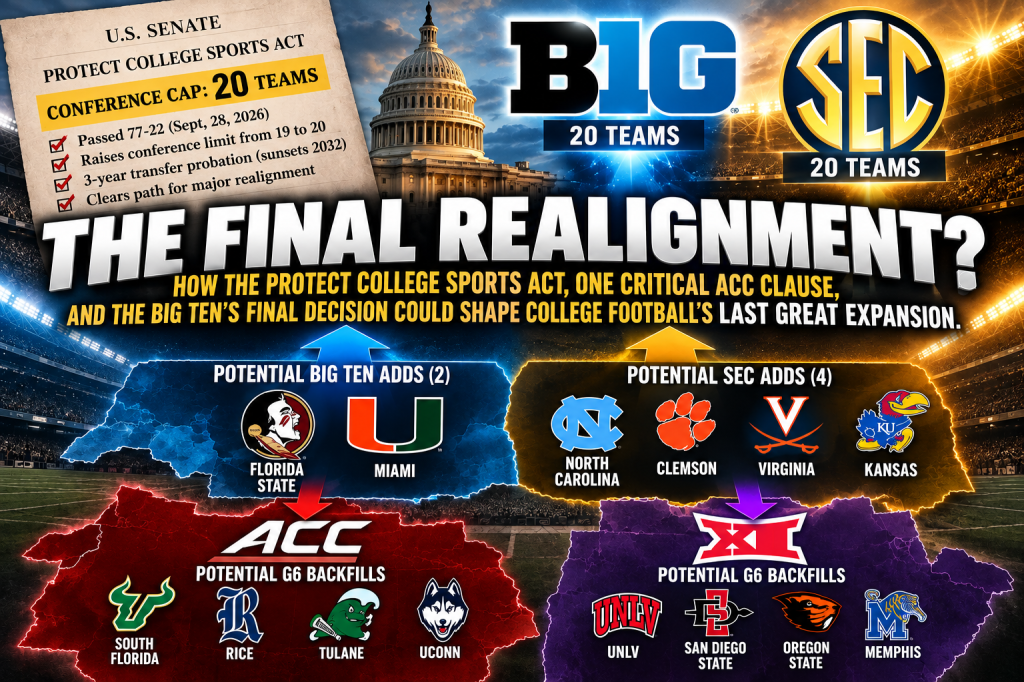
How the Protect College Sports Act’s new 20-team ceiling could open six seats in the Big Ten and SEC and trigger one last massive realignment of the ACC, Big 12 and Group of Six.
Updated September 29, 2026: When I first examined the Protect College Sports Act in August, one number appeared capable of determining the future map of college football: 19. (https://theramblinroundup.com/2026/08/01/the-final-realignment-how-the-protect-college-sports-act-one-critical-acc-clause-and-the-big-tens-final-decision-could-shape-college-footballs-last-great-expansion/)
At a 19-team conference cap, the math was brutally restrictive. The Big Ten, already sitting at 18 members, would have room for only one additional university. The SEC, with 16, could add three.
That created four potential seats in the sport’s two wealthiest conferences and forced an uncomfortable question: If Florida State, Clemson, Miami and North Carolina all wanted access to the Big Ten or SEC, would there actually be enough chairs when the music stopped?
Now the number has changed and so has the entire realignment equation. On September 28, the U.S. Senate passed the Protect College Sports Act of 2026, S.4668, by a bipartisan 77-22 vote. More importantly for conference realignment, the Senate-approved legislation included a late amendment raising the proposed maximum size of a power conference from 19 members to 20.
That seemingly minor change creates two potential openings in the 18-member Big Ten and four in the 16-member SEC.
Six seats.
And six seats could be enough to redraw the map of major college football. There is one critical qualification: the PCSA is not yet law. The Senate has passed it, but the House must still approve legislation and the president must sign it before these provisions become federal law.
Still, for the first time, we can see what Congress’s proposed guardrails might actually look like. If the 20-team limit survives the legislative process, the question may no longer be whether another major realignment occurs.
The question becomes: Which six schools get the final invitations?
Why 20 Changes Everything
The difference between 19 and 20 sounds insignificant. In college football realignment, it is enormous. The current Power Four membership looks like this:
Big Ten — 18
SEC — 16
ACC — 17 football members
Big 12 — 16
Those membership totals remain unchanged entering the 2026 season. Under a 19-team ceiling, the Big Ten and SEC could collectively add four schools. Under a 20-team ceiling, they could collectively add six.
That additional pair of openings dramatically increases the pressure on the ACC because the conference contains several of the most obvious remaining expansion candidates.
Florida State.
Miami.
Clemson.
North Carolina.
Virginia.
And potentially a few others.
It also means the Big 12 can no longer assume that the next raid would exclusively target the ACC. A school such as Kansas could become part of the conversation if the SEC or Big Ten believes it adds enough basketball value, national brand strength and institutional value to justify expansion. Kansas has already been discussed in national realignment conversations surrounding the PCSA.
That creates something college football has not previously confronted: A congressionally defined finish line. The Big Ten and SEC wouldn’t have unlimited opportunities to expand. They could go to 20 and then, assuming the provision survives intact, the door closes.
That turns expansion into a six-chair game of musical chairs.
The Other Amendment That Matters: The Clock Is Ticking Toward the 2030s
The 20-team limit isn’t the only important change. The revised legislation also shortened the proposed waiting period for a Power Four school moving from one power conference to another. Earlier versions contemplated a five-year period as an independent. The updated legislation reduces that period to three years.
Even more importantly, that restriction sunsets six years after enactment. That date matters enormously. If enacted in 2026, the restriction could disappear around 2032 or in 2027 it would disappear around 2033.
Now look at the media calendar. The Big Ten’s current media arrangement approaches its next negotiating window around the end of this decade. The Big 12’s deal also approaches expiration around 2030. The SEC has a “lookin: in 2030. The ACC’s revised exit structure is moving in exactly the same direction.
Following the ACC’s settlement with Clemson and Florida State, a school’s exit payment begins around $165 million and declines by approximately $18 million annually before reaching $75 million in 2030-31. A departing school that pays the required amount can leave with its media rights.
Put those pieces together. 2030-32 could become college football’s realignment window. The exit cost becomes considerably lower. Major television contracts reach negotiating periods. If the Senate language becomes law, the federal waiting-period restriction eventually disappears.
That does not guarantee realignment, but it creates the conditions for it.
So Who Gets the Six Seats?
There are numerous possible combinations, and neither conference has announced an expansion plan, but if both leagues ultimately decide to use every available position under a 20-school cap, this is one plausible model.
BIG TEN
Florida State
Miami
SEC
North Carolina
Clemson
Virginia
Kansas
That would produce two 20-member conferences and remove five schools from the ACC and one from the Big 12. It is not the only possible configuration. However, it demonstrates just how dramatically the 20-team amendment changes the landscape.
BIG TEN TARGET NO. 1: FLORIDA STATE
Florida State remains one of the most consequential brands outside the Big Ten and SEC. Its value isn’t complicated. Football history, national championships with a massive fan base. Florida recruiting along with a national television recognition. Most importantly entry into one of America’s most important college-football states. The BIGTEN Network could cash in.
Florida State has also spent years publicly confronting the ACC’s financial structure, culminating in litigation that ultimately produced the revised ACC revenue and exit arrangement. Under the old 19-team scenario, adding Florida State presented the Big Ten with a serious dilemma because doing so potentially consumed its only available opening.
At 20?
That dilemma changes. The Big Ten could add Florida State and somebody else, and that second seat may be just as consequential.
BIG TEN TARGET NO. 2: MIAMI
The second choice could come down to several schools. North Carolina would unquestionably be part of any serious conversation. Virginia offers academics, geography and access to another major state. Georgia Tech provides Atlanta, although Brent Key is proving to be fools gold as the boosters allowed Buster Faulkner, and several position coaches along with the starting QB, Center, TE, and WR to leave in favor of being all in on Brent Key which looks like the second coming of Geoff Collins while Buster Faulkner is looking like the next Urban Meyer. GT AD left for Michigan State and now the President is leaving for some non-profit gig in Colorado instead of dealing with the mess on the Flats. Actually remove Georgia Tech as they are probably removed off of any expansion list for the time being until they can get some clarity around their athleticTHE NOTRE DAME PROBLEM programs.
Notre Dame remains the ultimate wild card because it is already independent in football, but if Notre Dame remains independent, Miami becomes an intriguing partner for Florida State. Miami gives the Big Ten another Florida property and a major South Florida presence. As this would also allow the Bigten network to charge 100% carriage fees in the entire state, a windfall that might just be to big to pass up.
The Hurricanes also enter this conversation with renewed football relevance. Miami reached the national championship game following the 2025 season and has remained nationally prominent in 2026. Unlike Georgia Tech, they have clarity and are on a multi year upward trajectory that can be very advantageous.
A Florida State-Miami combination would also give the Big Ten something expansion has repeatedly pursued: inventory in a major recruiting and television territory.
Imagine a Big Ten footprint containing USC, UCLA, Oregon and Washington on the Pacific Coast, Nebraska and Iowa through the Plains, Ohio State and Michigan in the Midwest, Penn State on the East Coast and Florida State and Miami in Florida.
At that point, the name “Big Ten” would describe history rather than geography, but that transformation began years ago.
THE NOTRE DAME PROBLEM
There is one enormous variable. Notre Dame! If Notre Dame eventually decides that independence no longer serves its interests and chooses the Big Ten, the entire equation changes. A 20-team Big Ten with Notre Dame has only one remaining opening.
Then the conference may have to choose among Florida State, Miami, North Carolina and others. Notre Dame therefore remains the single biggest potential disruptor to every 20-team scenario. Until the Irish make a different decision about football independence, however, modeling two other additions remains reasonable.
THE SEC HAS FOUR CHAIRS
The SEC’s situation is even more fascinating. At 16 members, a 20-team ceiling gives commissioner Greg Sankey and the league’s presidents four possible additions.
The conference doesn’t need to expand. That distinction matters. Expansion only makes economic sense if the additional schools create enough value to avoid reducing the existing members’ distributions. If the SEC eventually decides four additions improve its long-term position, the league has an extraordinary collection of possibilities.
My hypothetical four: North Carolina, Clemson, Virginia, Kansas
NORTH CAROLINA: PERHAPS THE MOST IMPORTANT SWING SCHOOL
North Carolina could fit either the Big Ten or SEC. That is exactly what makes UNC so important. The Tar Heels provide a flagship university in a large and growing state, elite basketball history, a recognizable national brand and a geographic bridge into territory neither conference currently controls with an in-state member.
North Carolina has also been among the ACC programs positioned near the top of the conference’s value-based revenue discussions. ESPN previously reported that Clemson, Florida State, Miami and North Carolina were expected to sit near the top of the ACC’s brand-value structure.
If the SEC moves to 20, North Carolina would logically receive serious consideration.
CLEMSON: THE CULTURAL FIT
Few potential additions look more naturally “SEC” than Clemson. The Tigers sit in the heart of SEC territory. Clemson already maintains one of college football’s great annual SEC rivalries against South Carolina. Its fan culture resembles the SEC.
Its football history provides national recognition, and geographically, Clemson would require virtually no explanation.
The ACC’s move to nine conference games and the SEC’s own scheduling changes have already complicated future nonconference scheduling. Georgia and Clemson recently canceled their scheduled 2029, 2030, 2032 and 2033 series, although neither school publicly attributed that decision to conference realignment.
Clemson-to-the-SEC has been speculated about for years. A 20-team cap simply makes the arithmetic possible.
VIRGINIA: THE EXPANSION PLAY PEOPLE SHOULDN’T IGNORE
Virginia doesn’t create the same football headlines as Florida State or Clemson. If conference expansion isn’t determined solely by last Saturday’s score, then Virginia offers the SEC something it does not currently possess: A flagship presence in the Commonwealth of Virginia.
It also extends the conference’s footprint naturally northward while pairing cleanly with North Carolina.
A four-school addition of: North Carolina, Virginia, Clemson, and Kansas would expand the SEC into two new states while reinforcing its position in the Carolinas.
Virginia Tech could certainly enter this conversation as an alternative, particularly if football culture and regional identity carry more weight, but Virginia deserves to be considered among the serious institutional candidates.
KANSAS: THE BIG 12 WILD CARD
Here is where the 20-team amendment potentially becomes dangerous for the Big 12. Everyone naturally focuses on the ACC, but why assume all six additions must come from the ACC? Kansas provides one of the most recognizable brands in college athletics because of men’s basketball, has AAU membership and sits adjacent to the SEC’s existing footprint through Missouri. Kansas has already surfaced in discussions about what expansion candidates could offer the Big Ten or SEC under the proposed legislation.
Would Kansas generate enough incremental television revenue to justify SEC membership? That is the billion-dollar question, but a 20-team SEC could theoretically build something resembling: North Carolina — Virginia — Clemson — Kansas while the Big Ten takes: Florida State — Miami
And suddenly six chairs are gone.
WHAT HAPPENS TO THE ACC?
This is where realignment becomes a chain reaction. Start with today’s 17-team football ACC. Remove:
Florida State
Miami
Clemson
North Carolina
Virginia
The ACC falls to 12 football members. Those remaining schools would be:
Boston College
Cal
Duke
Georgia Tech
Louisville
NC State
Pittsburgh
SMU
Stanford
Syracuse
Virginia Tech
Wake Forest
That is still a viable conference, but it would be a dramatically different conference, and now commissioner Jim Phillips would face an immediate decision: Does the ACC go to 14 solely to keep the ACC contract or do they go to 16 to add some protective padding?
History says conferences rarely choose contraction when expansion can protect inventory. Several Group of Six schools would suddenly receive the phone call they have been waiting years to receive.
ACC BACKFILL NO. 1: SOUTH FLORIDA
USF should be at or near the top of the ACC’s list. The reason becomes even stronger if Florida State and Miami leave. Without those two schools, the ACC loses its presence in Florida. USF immediately restores it. Tampa is a major market.
Florida remains one of America’s premier recruiting territories, and USF has spent years positioning itself for another opportunity at the power-conference level.
Even USF-focused coverage acknowledges that the Bulls continue to surface in Power Four expansion discussions, although no conference has publicly identified USF as a target. In a diminished ACC without FSU and Miami, the calculation changes substantially. USF wouldn’t simply be another expansion candidate. It could fill a geographic hole.
ACC BACKFILL NO. 2: TULANE
Tulane brings something different. New Orleans. Academic credibility. A football program that has elevated its national profile, and geographic compatibility with SMU and potentially RICE.
For an ACC trying to maintain a national identity rather than retreat entirely to the Atlantic Coast, Tulane just makes to much sense.
ACC BACKFILL NO. 3: RICE
Rice may be one of the most overlooked schools in the next round of ACC expansion. If the ACC loses several of its biggest brands to the Big Ten and SEC, the conference’s response may not simply be about finding the strongest available football programs. It could also be about preserving television markets, academic identity, recruiting territory and geographic partnerships.
That is where Rice becomes interesting. The Owls give the ACC another foothold in Houston, one of the largest television markets in the United States and one of the country’s most important football recruiting regions. For a conference that has already expanded its footprint into Texas with SMU, adding Rice would deepen rather than merely extend that investment.
There is also an obvious travel component. SMU and Rice could function as Texas partners. SMU gives the ACC Dallas-Fort Worth. Rice gives it Houston. Instead of having one geographically isolated Texas member, the conference would have institutions in the state’s two enormous metropolitan areas.
Rice also fits an important part of the ACC’s traditional institutional identity. The university is a member of the Association of American Universities (AAU) and is one of the nation’s highly regarded research universities. That academic profile could matter considerably to an ACC that might still contain institutions such as Duke, Stanford, Cal, Georgia Tech, Boston College, Pittsburgh and Syracuse.
Then there is Tulane. Adding Rice and Tulane together could create a logical southern corridor for a rebuilt ACC: SMU — Rice — Tulane gives the ACC Network: Dallas -Houston -New Orleans. Those three institutions would give the ACC a more coherent presence across Texas and the Gulf Coast while providing natural regional opponents for one another.
Rice would still face an obvious question: football value.
But that may be the wrong way to evaluate the next ACC. If five major programs depart, there probably isn’t a Group of Six school capable of individually replacing Florida State or Clemson’s media value. The ACC instead may need to assemble the strongest collection of institutions available. In that scenario, Rice offers several assets at once:
Houston market and recruiting access.
Elite academics.
AAU membership.
A natural partner for SMU.
A potential regional grouping with Tulane.
Another major Texas presence for the ACC.
That combination could make Rice considerably more attractive to a rebuilding ACC than its football record alone might suggest. Imagine a new southern wing consisting of: SMU — Rice — Tulane — South Florida
The ACC would have a presence in Dallas-Fort Worth, Houston, New Orleans and Tampa while retaining access to three of the most talent-rich football regions in the country: Texas, Louisiana and Florida.
That would not recreate the ACC that existed with Florida State, Clemson, Miami and North Carolina. It would represent something different. A conference using markets, academics, geography and recruiting territory to build its next identity.
And if that becomes the strategy, don’t overlook Rice. Houston may be too valuable for the ACC to ignore.
ACC BACKFILL NO. 4: UCONN
Then there is UConn: basketball alone makes Connecticut difficult to ignore. Geographically, UConn also works with Boston College and Syracuse.
Football remains the complication.
Interestingly, UConn has continued exploring conference possibilities. Recent reporting says UConn contacted the American about potential football-only membership, though the American currently has no plans to expand and UConn officials have disputed aspects of that reporting.
A rebuilt ACC could offer something completely different: Power-conference membership and a basketball league UConn could legitimately embrace.
THE NEW 16-TEAM ACC?
If five major brands depart and the ACC responds with four additions, the rebuilt conference could look like this:
Boston College
Cal
Duke
Georgia Tech
Louisville
NC State
Pittsburgh
SMU
Stanford
Syracuse
Virginia Tech
Wake Forest
South Florida
Tulane
Rice
UConn
That is a 16-team league. Would it generate Big Ten or SEC money? Almost certainly not under today’s economics. Would it still contain major markets, respected academic institutions, nationally recognized basketball brands and credible football programs?
Absolutely.
And that distinction is important. The 20-team amendment does not necessarily kill the ACC. It could transform the ACC. The question becomes will the ACC be able to stay #3 in P4 pecking order.
THEN THE BIG 12 HAS A DECISION
Now assume Kansas takes the SEC’s 20th seat. The Big 12 drops from 16 to 15.
Brett Yormark would have little reason to sit still. The obvious strategy would be to restore membership while strengthening the league’s western inventory, and there are several fascinating possibilities.
BIG 12 TARGET NO. 1: UNLV
Few remaining Group of Six candidates provide the combination of geography, market and entertainment potential offered by UNLV. Las Vegas has become one of America’s most important sports cities. Allegiant Stadium provides an NFL-caliber venue. UNLV also negotiated something extraordinarily important when it committed to remain in the Mountain West: the university retained flexibility to pursue membership in an autonomous Power Four conference without penalty if such an opportunity became available.
That clause could become extremely valuable. If the Big 12 loses Kansas and wants another western property: UNLV should expect the phone to ring.
BIG 12 TARGET NO. 2: SAN DIEGO STATE
San Diego State is no longer in the Mountain West. The Aztecs officially joined the rebuilt Pac-12 on July 1, 2026 alongside Boise State, Colorado State, Fresno State, Gonzaga, Texas State and Utah State, joining Oregon State and Washington State in the new conference. That matters because many old realignment models are already outdated.
But membership in the Pac-12 doesn’t mean SDSU could never become a Big 12 target. Southern California remains strategically valuable.
The Big 12 already stretches from Arizona to Florida. San Diego would add another major western market and create another foothold in California. The contractual economics would determine whether such a move is practical.
BIG 12 TARGET NO. 3: OREGON STATE
Oregon State also deserves consideration. The Beavers are now one of the foundational members of the rebuilt Pac-12. If the Big 12 were suddenly looking west again, Oregon State would offer a former Power Five institution, an established fan base and another Pacific-time-zone property.
The same argument applies to Washington State, however Oregon State is the better pick and unfortunately Washington State gets left behind.
BIG 12 TARGET NO. 4: MEMPHIS
If there is one Group of Six institution that has spent years standing outside the Power Four window knocking on the glass, it is Memphis. The Tigers have pursued major-conference opportunities repeatedly.
CBS Sports reported that Memphis previously proposed an extraordinarily aggressive path into the Big 12 that included potentially foregoing conference distributions for five years and bringing substantial outside financial commitments. The Big 12 declined, but the effort demonstrated how seriously Memphis views Power Four membership. The Big12 could finally take Memphis up on its proposal.
If Kansas leaves and the Big 12 wants to grow rather than simply replace one member, the league could consider adding three of the four to get to 18, or maybe Yormark grabs 5 to get to 20 if the TV deal is going to add the amount of dollars to back expansion:
UNLV
San Diego State
Oregon State
Memphis
That would take the Big 12 from 15 following a Kansas departure all the way to 18 or maybe even 20.
THE PAC-12 COULD GET HIT AGAIN
There is another consequence nobody should overlook. The rebuilt Pac-12 finally began its new era on July 1, 2026 with Oregon State, Washington State, Boise State, Colorado State, Fresno State, San Diego State, Texas State, Utah State and non-football member Gonzaga.
But another Power Four expansion could restart the process. If the Big 12 loses Kansas and raids the Pac-12, the Pac-12 may have to rebuild again.
If the ACC takes USF, Rice and Tulane, the American may have to rebuild. If the American then raids the Pac-12, Mountain West, Sun Belt, Conference USA or MAC, those leagues have decisions to make.
Realignment moves downhill. One Big Ten invitation can eventually affect five conferences.
THE SIX-TEAM DOMINO
Here is one hypothetical chain.
BIG TEN TO 20
Florida State
Miami
SEC TO 20
North Carolina
Clemson
Virginia
Kansas
ACC LOSES FIVE
Backfills with:
South Florida
Memphis
Tulane
UConn
BIG 12 LOSES KANSAS
Targets:
UNLV
San Diego State
Oregon State
Washington State
And then the Pac-12 and American begin evaluating their next moves.
Again, this is not a prediction of announced invitations.
It is a model demonstrating what the Senate’s 20-team limit makes mathematically possible.
THE SIX SCHOOLS THAT COULD DEFINE THE ENDGAME
If the Big Ten and SEC eventually fill all six available positions, the pool of serious candidates is larger than six. The most consequential names include:
Florida State — national football brand and Florida access
Miami — South Florida, recruiting, market and national brand
North Carolina — flagship institution with elite basketball value and access to North Carolina
Clemson — championship football brand and natural SEC geography
Virginia — flagship university and access to a state neither league currently occupies
Kansas — elite basketball brand and the clearest Big 12 wild card
Then come alternatives such as:
Virginia Tech
NC State
Georgia Tech
Duke
Utah
Arizona State
And towering over the entire discussion:
Notre Dame.
The Fighting Irish could instantly change the arithmetic.
THE BIGGEST LOSER FROM 19 BECOMING 20 MAY BE THE ACC
At 19, there weren’t enough seats for everyone. That offered the ACC a strange form of protection. The Big Ten had one opening. The SEC had three.
Even if both leagues expanded to the limit, only four schools could leave for the richest two conferences. At 20, six can. That doesn’t guarantee six departures.
But it removes one of the structural barriers protecting the ACC. That is why changing a single number may ultimately prove to be one of the most important provisions in the entire bill.
CONGRESS MAY HAVE CREATED A FINISH LINE
The original goal of conference-size restrictions was to restrain consolidation. A 20-team cap still does that. Neither the Big Ten nor SEC could simply absorb another conference wholesale under this framework.
But 20 also leaves enough room for both conferences to make one final strategic expansion. That distinction matters enormously. The Big Ten can add two. The SEC can add four.
The ACC possesses many of the most attractive remaining candidates. The Big 12 possesses at least one intriguing wild card in Kansas and could become either a target or a beneficiary of the fallout.
Meanwhile, programs such as South Florida, Memphis, Tulane, UConn and UNLV suddenly have something they desperately need: a path. Not a guarantee.
A path.
The Final Realignment?
When this article was originally written, the central question was whether a 19-team ceiling would freeze college football before the Big Ten and SEC could complete their expansion. After September 28, that question has changed. The Senate’s answer is now 20. That means two potential Big Ten seats. Four potential SEC seats. Six opportunities, and potentially dozens of downstream consequences.
The next transformation probably doesn’t happen tomorrow. The legislation still must become law. The economics still must work. Media partners still matter. Conference presidents still have to approve expansion. Schools still have contracts and exit obligations, and Notre Dame still controls perhaps the biggest wild card on the board.
But look toward 2030, 2031 and 2032. ACC exit costs decline. Media agreements approach critical negotiating periods, and the proposed federal three-year independence restriction could eventually sunset. For years, everyone in college football has wondered when realignment would finally stop.
The Protect College Sports Act may not stop it immediately. Instead, Congress may have accidentally drawn the boundaries for one last enormous round.
And if the Big Ten and SEC eventually decide to fill all 40 seats available to them, college football’s final realignment may not be a battle over dozens of schools.
It may come down to six invitations, and everybody else will have to react.


Leave a comment