
By Luke Fletcher | Fort Collins, Colorado
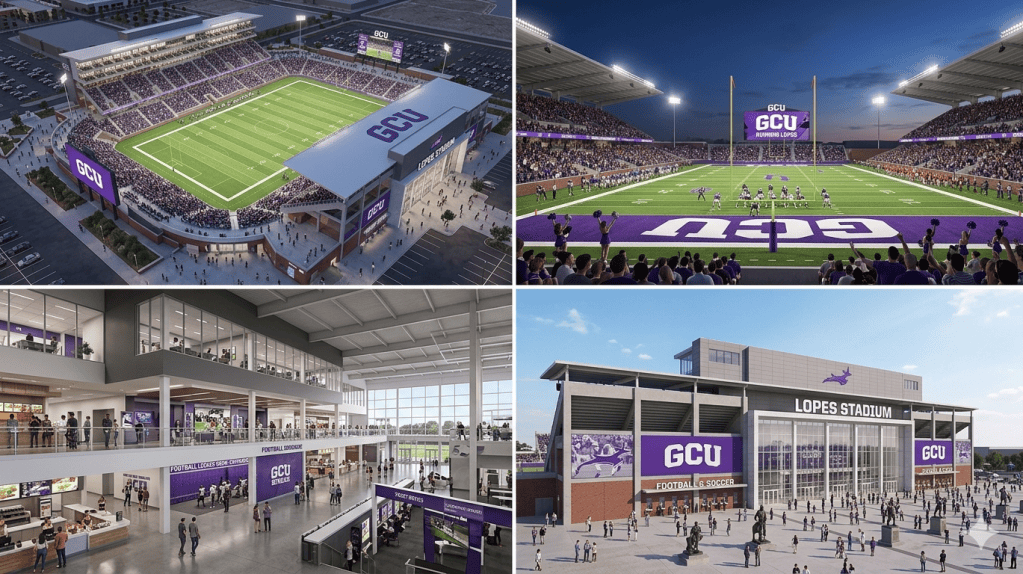
As Grand Canyon University prepares to officially settle into its status as a full member of the Mountain West Conference, a lingering question continues to captivate the college sports landscape: Could the Lopes field a Division I football team?
While GCU currently sits as a non-football member, the university’s rapid institutional growth, robust financial backing, and high-end athletic brand make the idea of “Lopes Football” a fascinating, and legally complex, possibility. If GCU leadership ever decides to bring gridiron action to Phoenix, the athletic department will have to navigate a strict multi-million dollar architectural overhaul and a compliance juggling act.
Here is the strategic blueprint for how GCU could realistically build a college football program from the ground up:
Phase 1: The Stadium Redesign (The Kennesaw Model)
GCU would not need to lease State Farm Stadium in Glendale, as the high operational costs and massive 63,000-seat capacity of an NFL venue create immediate financial strain for a startup program. Instead, GCU could follow the exact blueprint laid out by Kennesaw State University’s Fifth Third Stadium, transforming its elite, existing on-campus soccer pitch into a dual-purpose football facility.
A physical redesign of GCU Stadium would require a $75 million to $120 million investment to shift the facility into an enclosed, multi-tier bowl footprint:
- Enclosing the Bowl: The three open grass berms currently lining the field would be excavated. In their place, builders would erect permanent concrete stands, wrapping the end zones to scale capacity toward the mandatory 15,000 to 20,000-seat mark required for FBS football attendance.
- Surface Overhaul: The existing natural Bermuda turf would be replaced with a premium woven hybrid turf system (similar to the PlayMaster system used by Kennesaw State). This allows GCU’s nationally competitive soccer programs to share a pristine surface with a heavy-impact football team.
- Football Operations Complex: Beneath the stands or in an adjacent annex, GCU would construct a dedicated fieldhouse featuring modern locker rooms for 100+ athletes, sports medicine clinics, and expanded multi-level media press boxes.
Phase 2: The Title IX Compliance Blueprint
Adding an FBS football team immediately introduces roughly 85 to 110 male roster spots to an athletic department. Because GCU’s traditional on-campus student body slants heavily female (roughly 60% to 65%), the university faces a massive hurdle under federal Title IX laws, which mandate that athletic opportunities reflect student demographics.
To survive a Title IX compliance audit, GCU would have to execute a calculated “Roster Swap” to balance the scales:
- The Tactical Reductions: To safely absorb 100 football players, GCU would look to temporarily drop lower-roster men’s Olympic sports, specifically Men’s Swimming & Diving (approx. 25 spots) and Men’s Tennis (approx. 10 spots). This drops the immediate male roster expansion down to a net of 65 spots.
- Rapid Women’s Sport Expansion: Simultaneously, GCU would launch three high-volume women’s varsity teams to aggressively build out female athlete numbers:
- Women’s Rowing/Crew (+50 spots): Utilizing a boathouse partnership at nearby Tempe Town Lake or Lake Pleasant.
- Women’s Lacrosse (+30 spots): Sharing the newly redesigned multi-sport stadium footprint.
- Women’s STUNT or Rugby (+25 spots): Utilizing existing campus arena space.
+——————————————+—————————+
Title IX Roster Adjustment – Roster Impact Details
+——————————————+—————————+
ADD: Football (Men’s Varsity) +100 Male Athletes
ADD: Women’s Rowing / Crew +50 Female Athletes
ADD: Women’s Lacrosse +30 Female Athletes
ADD: Women’s STUNT or Rugby +25 Female Athletes
CUT: Men’s Tennis -10 Male Athletes
CUT: Men’s Swimming & Diving -25 Male Athletes
+——————————————+—————————+
NET ADJUSTMENT BALANCE – Compliance Maintained
+——————————————+—————————+
Phase 3: The Restorations (The Safe Harbor Path)
Eliminating men’s tennis and swimming would undoubtedly trigger backlash, but GCU could utilize Title IX’s “History and Continuing Practice of Program Expansion” (Prong 2) framework to eventually bring them back.
Once the football team is established and generating revenue (typically 3 to 5 years post-launch), GCU can safely reinstate men’s swimming and tennis only if they add matching women’s sports at the exact same moment. For example, bringing back those 35 male spots would require the simultaneous creation of Women’s Field Hockey and Women’s Gymnastics.
- The Endowment & Fundraising Loophole: The most effective way a university accelerates this reinstatement timeline is through targeted donor funding. If swimming or tennis alumni step forward and fully endow the programs, covering all scholarships, coaching salaries, and travel costs permanently, it removes the financial burden from the university. This allows the athletic department to redirect institutional funds purely toward launching the balancing women’s teams, drastically speeding up the timeline required to bring the cut sports back.
The Reinstatement Operational Flow:
                  [ STEP 1: FINANCIAL ACTIVATION ]
             Alumni & Corporate Donor Endowment Pool
                                |
             +------------------+------------------+

             |                                     |
             v                                     v
     Men's Tennis Fund                     Men's Swim/Dive Fund
($0 Institutional Cost)                 ($0 Institutional Cost)

             |                                     |
             +------------------+------------------+
                                |
                  [ STEP 2: ROSTER BALANCING ]
  Simultaneous Launch of Matching Women's Varsity Programs
                                |
  +-------------------------------------------------------------+

  |  REINSTATE MEN'S SPORTS        |   MATCHING WOMEN'S SPORTS  |
  +--------------------------------+------------ ---------------+

  |  +10 Men's Tennis Roster       |   +25 Women's Field Hockey |
  |  +25 Men's Swimming & Diving   |   +15 Women's Gymnastics   |
  +--------------------------------+----------------------------+
                                |
               [ RESULT: TITLE IX COMPLIANCE MET ]
Phase 4: The Phoenix TV Market Advantage
The Phoenix metropolitan area is the 11th largest television market in the United States, containing over 2.1 million TV households. For a conference like the Mountain West, anchoring a program in this specific media market provides a massive financial and structural boost.
- Valuable Inventory: College football is the primary driver of modern sports television revenue. Adding a Phoenix-based program provides networks like CBS Sports and FOX Sports with high-value game inventory in the Mountain Time Zone, unlocking lucrative late-night viewing windows.
- Local Corporate Synergy: Phoenix serves as the national headquarters for major corporate brands like U-Haul, Best Western, DriveTime, and Carvana. A Division I college football program situated in the heart of the city creates instant, localized advertising and commercial broadcast opportunities that smaller college towns simply cannot match.
Phase 5: The Capital Campaign Blueprint (“Lopes on the Gridiron”)
To fund a $100 million stadium renovation and establish a $50 million sports endowment to protect Title IX programs, GCU would need to launch a massive, highly structured donor fundraising campaign.
- The Quiet Phase & Leadership Gifts: Before publicizing the project, the university secures anchor commitments from high-net-worth individuals, institutional trustees, and primary corporate partners. This includes securing a marquee corporate entitlement partner to rename the renovated facility (e.g., “Carvana Stadium at Lopes Park”) alongside five to ten individual seven-figure commitments from elite athletic boosters to anchor the construction bonds.
- Premium Inventory Allocation: The athletic department monetizes the upcoming stadium infrastructure by preselling high-end, long-term luxury inventory to corporate entities. This involves leasing climate-controlled corporate luxury suites on multi-year terms and implementing mandatory seat licensing for premium midfield club levels.
- The Olympic Sport Endowment Drive: A highly targeted fundraising effort aimed specifically at swimming and tennis alumni to activate the Title IX safe harbor loophole. A prominent donor matching campaign could double alumni contributions, fully endowing the sports to ensure their immediate protection and eventual reinstatement.
- The Public Phase & General Engagement: The campaign opens to the general public, students, and alumni to drum up community engagement and close out the remaining construction balance. This final push features commemorative brick plazas and public season ticket deposit drives to demonstrate immediate fan demand directly to media partners.
Phase 6: The Desert Bowl – Hosting a Postseason Matchup
Transforming GCU Stadium into a winter college football hub opens the door for a brand-new postseason game: The Desert Bowl. Sanctioned as a premier tie-in for the Mountain West Conference against a top-tier Group of 6 (G6) opponent, this game would position GCU’s campus at the center of the national holiday sports calendar.
While the Valley of the Sun already hosts the iconic Fiesta Bowl in Glendale, a boutique bowl game inside the Phoenix urban core would tap into a highly successful national trend, similar to how the Bahamas Bowl or the Poinsettia Bowl thrived by creating high-energy, intimate atmospheres in destination markets.
Projected Annual Financial & Economic Impact
The launch of an annual bowl game at a redesigned GCU Stadium would generate significant economic activity, split between direct university revenue and regional tourism impact for the Phoenix metropolitan area.
+---------------------------------+---------------------------+

| Economic Impact Category             | Projected Annual Value    |
+---------------------------------+---------------------------+

| 1. Direct Out-of-State Visitor Spending  | $12.5M - $18M |
| 2. Hospitality & Hotel Room Bookings     | $4M - $6.5M |
| 3. National TV Media Broadcast Rights    | $2.5M - $4M |
| 4. Ticket Sales & On-Campus Concessions  | $1.8M - $2.8M |
+-----------------------------------------+-------------------+

| TOTAL ANNUAL ECONOMIC IMPACT            | $20.8M - $31.3M |
+----------------------------------+---------------------------+
- The Phoenix Regional Tourism Boost ($16.5M – $24.5M): A bowl game drawing two out-of-state fanbases fills an estimated 12,000 to 18,000 hotel room nights across Phoenix, Scottsdale, and Tempe during a peak winter tourism window. This central location funnels thousands of visiting fans directly into city restaurants, rental car agencies, and local entertainment districts, creating a massive influx of short-term sales tax revenue.
- Direct Athletic Department Revenue ($4.3M – $6.8M): By anchoring a prime-time or afternoon holiday broadcast window on major networks, the bowl game generates dedicated television rights payouts. As the venue owner, GCU retains lucrative revenue from ticket sales, premium luxury suite rentals, parking operations, and high-volume stadium concessions.
- The “Flutie Effect” and Brand Equity (Invaluable): A three-hour national television broadcast serves as a giant commercial for Grand Canyon University. This sustained media spotlight historically drives spikes in undergraduate applications, out-of-state enrollment, and general university merchandise sales long after the game end
The Verdict
The blueprint is clear, viable, and entirely within GCU’s financial capability. If the university has the institutional fortitude to launch a football program, it won’t be a quiet transition. It will require a $100 million stadium overhaul, a complete restructuring of the athletic department’s sports portfolio, a major capital campaign rollout, and an immediate leap into the high-stakes world of Division I college football. However, this move is set to boost revenue for both the university and the city of Phoenix. It’s not about “if” anymore; it’s about “when.” LopesUp, as GCU is Built Bold! Go Lopes!
 The Ramblin Roundup
Leave a comment