
By Luke Fletcher | Atlanta, Georgia
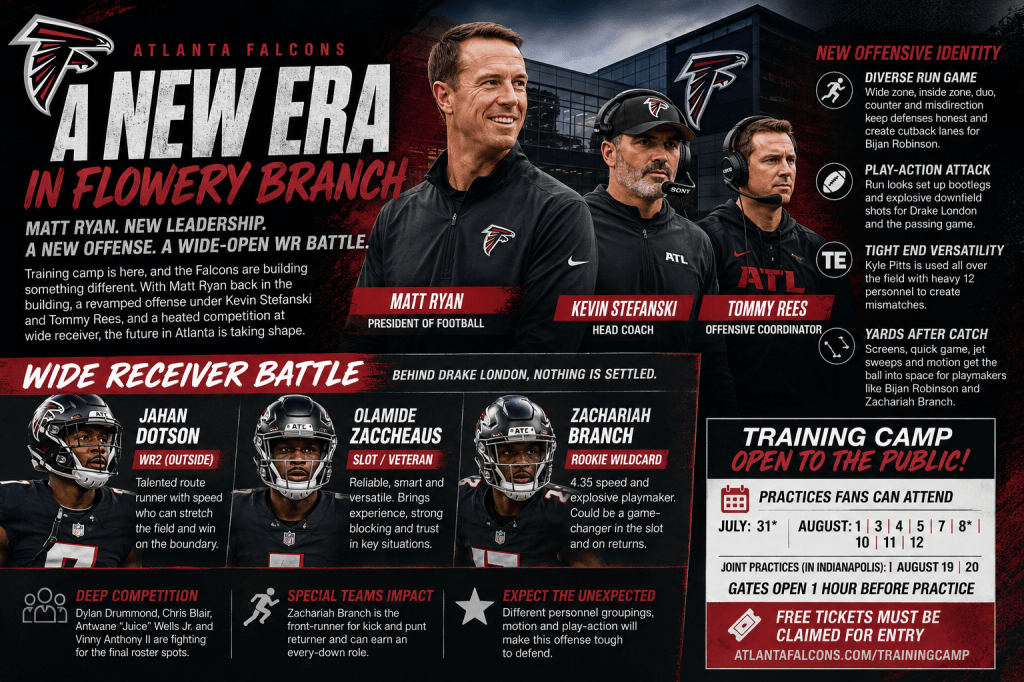
For the first time in a while, Atlanta Falcons training camp feels like more than the beginning of another season.
There is a new head coach, a new offensive system, a fascinating competition at wide receiver and one of the most important figures in franchise history back inside the building. Matt Ryan is no longer preparing to stand in the pocket and lead the offense. Now, he is helping shape the entire football operation as the Falcons’ president of football.
The first full-team practice is scheduled for July 29, and Atlanta will hold 10 practices that fans can attend during camp. Several sessions will take place at IBM Performance Field in Flowery Branch, while the schedule also includes a Saturday night event and joint practices in Indianapolis. Tickets for the public practices are free but must be claimed in advance, and gates open one hour before practice.
For Falcons fans, that means an opportunity to see this new chapter take shape up close.
Matt Ryan Returns with a Different Kind of Responsibility
Ryan’s playing days are over, but his influence on the Falcons may be entering an entirely new phase.
As Atlanta’s president of football, Ryan is involved in the organization’s broader football vision, working alongside ownership, the front office and the coaching staff. His value goes far beyond understanding quarterback play. He knows what successful preparation looks like, understands the pressure that comes with representing Atlanta and has experienced nearly every possible high and low an NFL franchise can encounter.
Players have already spoken positively about having him involved, and his presence gives the Falcons something few organizations possess: a senior football executive who understands the franchise from the perspective of a player, captain and former league MVP.
Ryan’s leadership was never built around demanding attention. It came from preparation, accountability and consistency. Those traits are especially valuable during training camp, when a new staff is establishing expectations and players are fighting for jobs.
He does not need to dominate meetings or interfere with the coaching staff to make an impact. Sometimes the most valuable thing he can do is ask the right question, share what he experienced as a quarterback or help connect the priorities of ownership, coaches and players.
That may be where his greatest value lies. Ryan understands what Falcons football has been, but he is now in a position to help determine what it becomes.
Kevin Stefanski and Tommy Rees Bring a New Offensive Direction
The Falcons’ new offensive identity will be shaped by head coach Kevin Stefanski and offensive coordinator Tommy Rees, who previously worked together in Cleveland. Rees joined Stefanski’s staff there as a tight ends coach and passing-game specialist before becoming offensive coordinator and eventually assuming play-calling duties. Stefanski has now entrusted him with calling Atlanta’s offense.
The expected foundation is a versatile running game connected closely to an aggressive play-action passing attack.
That begins with Bijan Robinson.
Atlanta can use outside-zone concepts to stretch defenses horizontally and create cutback opportunities for Robinson. The Falcons can then complement those plays with inside zone, duo, counter and misdirection. The objective is not simply to run the football more often. It is to present several different threats from similar formations and force defenders to hesitate.
That hesitation creates opportunities in the passing game.
Stretch-zone action can lead naturally into bootlegs and movement passes. Linebackers who step toward the run can leave space behind them. Safeties who become overly aggressive can expose one-on-one opportunities downfield.
That is where Drake London could become even more dangerous.
London is already established as the centerpiece of the receiving corps. A convincing play-action game should allow him to attack isolated defenders on posts, crossing routes and vertical throws rather than constantly catching passes against crowded coverage.
The Falcons also want to improve their ability to create yards after the catch. Screens, shallow crosses, quick throws and pre-snap motion can put the football into the hands of Robinson and Atlanta’s faster receivers without requiring the quarterback to hold the ball for an extended period.
The offense should look connected. The runs should resemble the play-action passes. The motions should force defensive communication. The formations should allow the same personnel to create several different possibilities.
Training camp will provide the first real indication of whether those ideas are becoming a functional NFL offense.
Kyle Pitts Remains One of the Biggest Questions
Rees’ background working with tight ends makes Kyle Pitts one of the most interesting players to watch.
Atlanta has spent years trying to determine the best way to use Pitts. He has the size of a tight end but possesses movement skills closer to those of a receiver. The challenge has been finding a role that takes advantage of his athletic ability without making the offense predictable whenever he moves around the formation.
Under Rees, Pitts could line up inline, in the slot, outside or as a movable matchup piece.
The presence of blocking tight ends gives Atlanta additional flexibility. In heavier personnel groupings, the Falcons can use sturdier blockers to help establish the running game while allowing Pitts to work against linebackers and safeties in space.
The goal should not be to force Pitts into a conventional tight-end role or simply treat him as another wide receiver. It should be to make his alignment difficult for the defense to interpret.
When Pitts is on the field, opponents should not immediately know whether Atlanta intends to run, throw underneath or attack down the seam.
Drake London Is the No. 1—Everything Else Is Open
There is no uncertainty at the top of Atlanta’s receiver room.
London is the Falcons’ primary target and the player around whom the passing game will be constructed. The real competition is behind him, where Jahan Dotson, Olamide Zaccheaus and rookie Zachariah Branch offer very different skill sets.
Dotson and Zaccheaus both have extensive experience playing outside and in the slot, giving the coaching staff the freedom to move them around rather than assigning each player one fixed position. The Falcons have described Dotson as a versatile receiver who plays bigger than his size, while Zaccheaus brings intelligence, experience and dependability in the middle of the field.
Dotson appears to be the most natural candidate to start outside opposite London. The former first-round selection has the route-running ability and vertical speed to benefit from Atlanta’s play-action game.
This opportunity could also represent a fresh start. Dotson will need to show that he can consistently separate, finish plays and produce when defenses devote extra attention to London.
Zaccheaus, meanwhile, may enter camp with an early advantage in the slot because of his experience and reliability. He is familiar with Atlanta and has shown a willingness to block, contribute on special teams and handle different assignments.
In an offense that wants to shift formations without constantly changing personnel, that versatility matters.
But the veteran receivers will have to hold off one of the most exciting rookies on the roster.
Zachariah Branch Could Force His Way onto the Field
The Falcons selected former Georgia receiver Zachariah Branch with the 79th overall pick in the third round of the 2026 NFL Draft. He recorded 81 receptions for 811 yards and six touchdowns during his season with the Bulldogs while also contributing as a returner.
Branch brings immediate speed and open-field explosiveness to a receiver room that needed both.
He may not begin camp as a polished every-down starter, but he does not have to master the complete offense before contributing. Rees can create touches for him through screens, jet motions, quick crossing routes and other concepts designed to place him in space.
Branch’s speed can affect a defense even when he does not receive the ball. Sending him across the formation before the snap could pull defenders away from Robinson, create leverage for London or force the secondary to reveal whether it is playing man or zone coverage.
The rookie’s most direct competition could come against Zaccheaus for slot snaps, but the situation does not have to produce one clear winner.
Zaccheaus can provide reliability, blocking and third-down awareness. Branch can add acceleration and big-play potential. Atlanta could use both players according to down, distance and matchup.
Branch also has a strong opportunity to establish himself as a return specialist. Success on punts and kickoffs would give him immediate value while the Falcons gradually expand his offensive responsibilities.
A few explosive plays during camp or the preseason could quickly change the receiver hierarchy.
The Receiver Battle Is About More Than a Depth Chart
The Falcons may list one player as WR2 and another as the starting slot receiver, but the actual competition is about earning roles within different personnel packages.
London and Dotson could start outside when Atlanta uses three receivers. Zaccheaus could work from the slot in more traditional situations. Branch could enter for packages built around speed, motion and yards after the catch.
Pitts will influence the rotation as well. When Atlanta uses two tight ends, only two receivers may be on the field. That makes blocking, route discipline and reliability especially important because every snap must be earned.
The competition at the bottom of the room will be equally intense. Dylan Drummond, Chris Blair, Antwane “Juice” Wells Jr. and Vinny Anthony II will need to contribute on special teams and demonstrate positional flexibility to claim the final roster spots. Atlanta’s own camp preview identified the receiver hierarchy behind London as one of the roster’s major unanswered questions.
What Fans Should Watch at Open Practices
Because training camp is open to the public on selected dates, fans will be able to watch these competitions unfold rather than simply reading about them afterward.
The first thing to monitor is who lines up with the starting offense. Does Dotson consistently work outside opposite London? Does Zaccheaus receive the first slot repetitions? How quickly does Branch begin appearing in designed packages?
It will also be worth watching how frequently the offense uses motion, two-tight-end sets and play-action. Those details will reveal how Rees intends to combine Atlanta’s running game with its passing attack.
Fans should also pay attention to Ryan. He will not be calling plays or coaching an individual position group, but where he spends his time and how he interacts with players and coaches will offer insight into how he is approaching his new leadership role.
The Falcons’ open-practice schedule includes sessions on July 31; Aug. 1, 3, 4, 5, 7, 8, 10, 11 and 12, with additional joint practices scheduled in Indianapolis on Aug. 19 and 20. The July 31 session is designated for season-ticket members, while the Aug. 8 event is the team’s Saturday night practice. Fans attending the available public sessions must claim free tickets before entry.
A Camp Filled with Possibility
Training camp optimism is nothing new. Every summer brings talk of fresh starts, breakout players and new systems.
This year, however, the Falcons truly are beginning something different.
Matt Ryan has returned with the authority to influence the organization’s football direction. Stefanski and Rees are installing an offense built around versatility, deception and play-action. London remains the established star, but Dotson, Zaccheaus and Branch are fighting to determine how the rest of the passing game will take shape.
None of that guarantees success once the regular season begins. New systems still require execution. Young players must prove themselves under pressure, and the offense must develop consistency at quarterback.
But for Falcons fans heading to Flowery Branch, there will be plenty worth watching.
The Matty Ice playing era may be over, but Ryan’s next chapter is beginning. At the same time, a new coaching staff and a rebuilt collection of playmakers are attempting to create an offense capable of finally turning Atlanta’s potential into production.
Training camp will offer the first look at whether all of those pieces can come together.
 The Ramblin Roundup
Leave a comment