
By Luke Fletcher | Fort Collins, Colorado
On the second Saturday of December, college football takes a rare pause. The transfer portal goes silent, and the usual buzz of recruiting chatter fades from social media. Discussions about NIL deals, revenue sharing, and conference shifts suddenly seem trivial.
For just a few hours, the sport reconnects with its roots through the iconic Army-Navy Game. The atmosphere is electric as the Corps of Cadets and the Brigade of Midshipmen march into the stadium, creating a stunning visual of future leaders in uniform. The national anthem resonates, and for this brief moment, the focus shifts away from money and controversy. Instead, it’s about two teams, a fierce rivalry, and a commitment to serve a greater purpose. The scoreboard takes a backseat to the pride and honor of representing their respective academies. Winning means bragging rights for a year, but both teams are destined to lead and serve the nation for years to come. This is why the Army-Navy Game transcends mere football; it has become a cherished American tradition.
Congress recognizes its significance, as seen in the proposed Protect College Sports Act, which aims to safeguard this game by ensuring it has its own national television slot, free from competition. This legislative move highlights the understanding that the Army-Navy Game is a vital part of college football’s identity, but it also prompts a larger conversation about the future of the sport.
What about every other Saturday?
The Army-Navy Game is a highlight in college football, but the programs behind it are facing unprecedented challenges. In just the last five years, college football has evolved more than it did in the previous half-century. Athletes now have the freedom to transfer like professional free agents, and revenue sharing is turning athletic departments into multimillion-dollar enterprises. The introduction of Name, Image, and Likeness compensation is a key factor in recruiting, with P4 and G6 programs ready to invest millions to secure top talent.
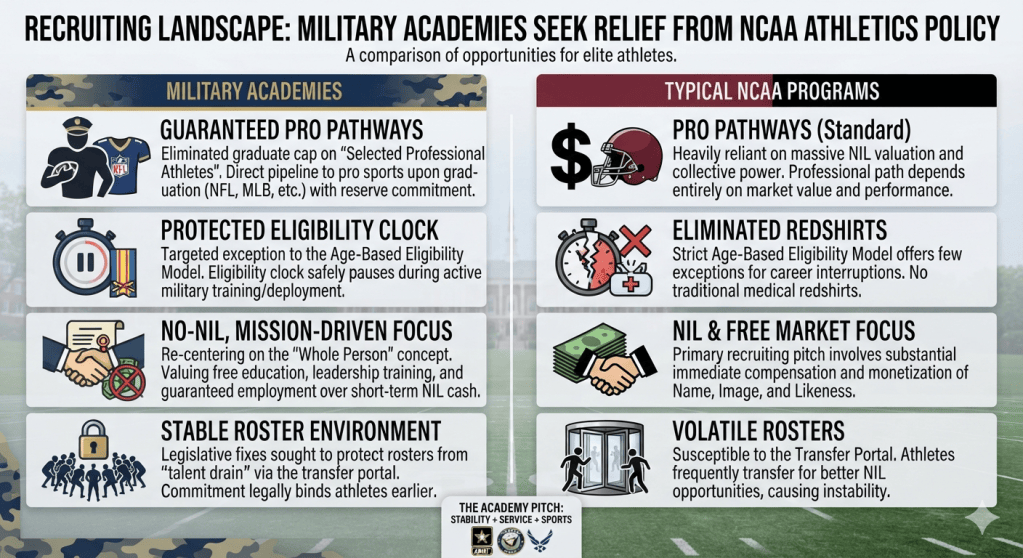
The Protect College Sports Act aims to bring stability by establishing national standards for NIL, transfers, and eligibility, but the academies’ long-term success will likely hinge on ongoing legislative efforts in Washington. If Congress embraces the recommendations from the Military Academies Seek Relief From NCAA Athletics Policy report, the academies could adopt a governance model that stands apart from the rest of college athletics.
Picture a future where military service pauses an athlete’s eligibility clock without the hassle of waivers, professional sports deferments offer a clear path to leagues like the NFL or MLB while fulfilling military duties, and transfer rules consider the unique timing of military commitments. Federal policymakers could create tailored solutions that respect the realities of college sports while upholding military ethics. While these changes won’t elevate Army, Navy, or Air Force to Power Four status, that’s not the aim. The more realistic goal is to ensure these academies remain competitive G6 contenders, capable of winning conference titles and securing bowl invitations, and every so often a CFP playoff spot.
The Three Structural Problems: Why the Rules Work Against the Service Academies and Why Change May Come
Every college football coach has their share of concerns, from recruiting to keeping players satisfied and replacing graduating seniors. However, coaches at Army, Navy, and Air Force face unique challenges that other programs don’t encounter. Their hurdles stem from federal law rather than just the usual depth chart issues. Academy leaders have been vocal with Congress, emphasizing that their struggle isn’t about coaching prowess but rather whether the existing regulations even allow them to compete effectively. The Congressional Research Service has pinpointed three key structural issues that set military academies apart from other Football Bowl Subdivision teams. Each of these issues poses its own set of challenges, but together, they jeopardize the future competitiveness of service academy football.
1. Name, Image, and Likeness
The introduction of Name, Image, and Likeness (NIL) opportunities has transformed recruiting, turning quarterbacks into brands and making endorsement discussions a norm even before recruits sign their National Letters of Intent. While many programs have embraced NIL as a valuable recruiting tool, for the service academies, it has become a significant barrier. Cadets and midshipmen are classified as active-duty military personnel and federal employees, which subjects them to ethics laws that prevent government workers from leveraging their positions for personal financial gain. These regulations were not designed with college football in mind, yet they clash with the financial realities of modern college athletics. Consequently, Army, Navy, and Air Force find themselves unable to engage in the NIL marketplace like nearly every other FBS school, not due to NCAA restrictions, but because of federal law.
2. Transfer Portal
One of the biggest headaches for academy coaches isn’t just losing out on recruits; it’s watching players they’ve nurtured leave. For years, institutions like Army, Navy, and Air Force thrived by spotting talent that others overlooked, athletes who needed time to grow and were committed to developing over four years. This approach worked well because player development was a priority. However, the landscape has shifted dramatically with the advent of the transfer portal. Picture a quarterback who, after being lightly recruited, blossoms into a star at West Point over two seasons. Just as he’s about to fulfill his military service, another university swoops in with enticing offers of immediate NIL deals and financial security, something the academy simply can’t match. This scenario is all too real for Army, especially after losing standout running back Kanye Udoh, who was a key player in their conference championship run. In the 2023-2024 season, he racked up an impressive 1,117 rushing yards and scored 10 touchdowns, earning a spot on the Second-Team All-AAC in 2024. Then he transferred, to Arizona State in 2025 and this has sparked serious discussions among academy officials and lawmakers. The transfer portal has inadvertently turned military academies into breeding grounds for civilian programs that can offer more financial incentives.
Congress is now looking into whether this trend not only creates an uneven playing field but also poses risks to military readiness. Rather than aiming to curb player movement, lawmakers are considering measures to prevent civilian schools from exploiting the academies as free talent sources, such as implementing earlier commitment dates or specific transfer protections. The ultimate aim is to safeguard the significant investment the academies make in shaping future leaders.
3. Recruiting
Recruiting discussions have shifted significantly in the last ten years, with one question now taking center stage in talks with top prospects: “Coach, what if I’m good enough for the NFL?” For players at powerhouse programs like Alabama, Georgia, or Ohio State, the path is clear: get ready for the Draft, attend the NFL Combine, and kick off a professional career. However, for those considering service academies, the situation is much more complex. Traditionally, graduates have had to fulfill military obligations before they can chase their dreams in professional sports, although there have been waivers in some cases. These policies have changed frequently, leading to confusion for both recruits and scouts. Picture offensive tackle torn between Boise State and West Point; one offers a straightforward route to the pros if they put in the work, while the other is mired in uncertainty due to military service requirements and shifting federal policies. This unpredictability can be a significant drawback in recruiting.
To address this, lawmakers are looking at expanding the Selected Professional Athlete program, which could remove limits on how many academy graduates can pursue professional sports right after graduation while still serving in the reserves. If this change happens, academy coaches could confidently assure recruits that if they have the talent, they can transition to professional play immediately after graduation while continuing to serve their country, a much more appealing message than what has been communicated in recent years.
At first glance, NIL restrictions, transfer portal issues, and professional sports delays might seem disconnected, but they actually share a common thread. All three issues arise from the unique position of service academies, which were established to train military leaders, while college football has transformed into a highly commercialized sport. The Protect College Sports Act initiates a crucial conversation by acknowledging the role of military service in college athletics.
Meanwhile, the Military Academies Seek Relief initiative delves deeper, examining how these academies can remain competitive within the Group of Six while upholding military readiness and the core values of college sports. This exploration has the potential to influence the future of service academy football significantly, as the primary challenge for the Army, Navy, and Air Force is not merely competing against dominant teams like Alabama, but rather ensuring they keep pace in the swiftly changing G6 college football environment.
What Congress Does Next: The Future of Service Academy Football May Be Decided in Washington
For years, the landscape of college football was shaped behind closed doors in locker rooms and administrative offices, but now it’s increasingly influenced by congressional hearings and legislative discussions. This shift might seem odd, yet it highlights the evolving nature of college athletics. As Congress delves into issues like transfer portals and revenue sharing, football has transformed into a significant political topic. This is especially true for the service academies, Army, Navy, and Air Force, where the athletic departments operate under both NCAA regulations and Department of War guidelines.
The complex issue of NIL is being discussed, with no serious proposals to turn service academies into NIL powerhouses, but there may be room for carefully crafted exceptions that align with federal ethics laws while acknowledging the current landscape of college sports. It’s still early in this conversation, but the fact that it’s taking place is noteworthy. The common misconception is that Congress wants the service academies to conform to the same standards as other colleges, but that’s not the case at all. There’s no expectation for Army to invest heavily in a $20 million NIL collective, for Navy to match Texas’s financial prowess, or for Air Force to recruit like Ohio State.
Some fans suggest that moving to the Football Championship Subdivision could be a solution, but that misses the point of why these academies compete at the FBS level. For most schools, football is just a way to showcase the university, but for the service academies, it serves a much deeper purpose. Each Army game on national TV, every Navy win, and all the Air Force bowl appearances are more than just sports; they’re chances for the public to see future military leaders in action. The Department of War doesn’t just look at academy football in terms of wins and losses; it’s a vital recruitment tool that highlights leadership and promotes the academies’ missions. Stepping away from the FBS would significantly cut down that visibility and, in turn, diminish one of the military’s most effective ways to connect with potential recruits.
The real aim is to maintain a competitive balance while upholding the core mission of military service. Success for these academies isn’t just about winning championships; it’s about the quality of officers they produce, the leaders they cultivate, and the trust they earn from the public. Football plays a supportive role in this mission rather than overshadowing it. Future legislation is likely to reflect this understanding, focusing on a model that respects federal ethics, acknowledges military duties, and fosters player development while maintaining the distinct role of academy athletics within the Armed Forces.
Some might question why Congress is focusing on just three football programs, but the reality is that this goes beyond sports. It raises important issues about how institutions with unique missions can thrive in a commercialized landscape. The challenges faced by the service academies could eventually impact other federally affiliated organizations that operate under legal constraints that private universities do not. In many ways, Army, Navy, and Air Force are at the forefront of this significant test. The question is whether Congress can adapt college athletics without forcing every institution into a uniform business model, and the outcome could have far-reaching implications for the future of higher education and intercollegiate sports. This distinction can easily be overlooked. The Protect College Sports Act (PCSA) and the initiative aimed at providing military academies relief from NCAA policies are often mentioned in the same breath, but they serve different purposes.
The PCSA is a national law designed to bring stability to college athletics as a whole, while the military academies’ effort is more focused, addressing how these institutions can stay competitive within the new framework. You can think of them as two parts of a whole: the PCSA lays the foundation, while the academy relief effort tweaks specific aspects. Without the PCSA, college athletics would remain in a state of legal confusion, and without tailored relief for the Army, Navy, and Air Force, these academies would still face unique challenges that civilian schools do not. Some have questioned why lawmakers didn’t just include broad NIL exemptions for the academies in the PCSA, but the reality is that those changes would involve a much larger scope, touching on federal ethics laws and military regulations. Instead of holding up comprehensive reforms for all Division I schools, lawmakers opted for a two-pronged strategy: first, stabilize the overall landscape with the PCSA, and then tackle the specific needs of the military academies separately, which is already in progress.
The Congressional Research Service’s review of the service academies isn’t focused on whether the Army, Navy, and Air Force deserve special treatment; rather, it’s questioning if the existing system inadvertently puts these institutions at a disadvantage due to their primary mission not being athletics. This is an important distinction to make. The academies aren’t seeking Congress’s help to outspend SEC schools; they want recognition that institutions training future military leaders shouldn’t be penalized for adhering to federal regulations. This shifts the conversation significantly. It could lead to federal changes in how the service academies attract and keep athletes, as well as how they compete in the Football Bowl Subdivision. While the Protect College Sports Act aims to stabilize college athletics, it doesn’t tackle the crucial issue of how service-oriented institutions can thrive in a sport that increasingly prioritizes commercial interests. The solution lies not just in the Protect College Sports Act but in a new legislative and policy initiative emerging in Washington, aimed at ensuring the service academies stay both relevant and competitive in today’s college football landscape.
It’s unlikely that the Army, Navy, or Air Force will exit the Football Bowl Subdivision or suddenly match the financial power of the SEC or Big Ten. Instead, the future seems to be a middle ground where these service academies will carve out a niche within the FBS over the next decade. Rather than engaging in a competition they can’t legally win, they’ll focus on their strengths: continuity, player development, discipline, and a strong sense of purpose.
The Protect College Sports Act aims to create a more stable environment by establishing national standards for NIL, transfers, and eligibility. However, the academies’ long-term success may hinge on new legislative efforts in Washington. If Congress adopts recommendations from the Military Academies Seek Relief From NCAA Athletics Policy report, we could see a unique governance model for the academies. This could lead to a future where military service pauses an athlete’s eligibility clock automatically, professional sports deferments offer a clear path to major leagues while fulfilling military duties, transfer rules consider the timing of military commitments, and federal policies are tailored to the realities of college athletics while upholding military ethics.
The aim isn’t just lofty ideals; it’s about keeping the academies as serious contenders in the G6, capable of clinching conference titles, securing bowl invitations, and vying for the top G6 spot in the College Football Playoff. They also want to show that discipline, growth, and a strong culture can triumph over financial might. Recent examples highlight this potential, like Army’s revival under Jeff Monken, which underscores the importance of stability. Navy has long demonstrated that developing players can outweigh recruiting rankings, while Air Force has earned respect as a solid program in the Mountain West. These achievements stem from consistency rather than flashy recruiting or hefty NIL deals, and as college football shifts towards a more transactional nature, this stability could become a key advantage for the academies.
The real question is whether college football’s governing structure will continue evolving in a way that recognizes the unique legal and institutional responsibilities the academies carry. If the answer is yes, Army, Navy, and Air Force won’t simply survive college football’s new era, they’ll carve out a distinctive place within it. Not as programs chasing the biggest NIL deals, nor as schools trying to imitate the SEC. But as institutions proving there is still room in modern college football for teams built on commitment, development, leadership, and service. In a sport increasingly defined by what players can earn today, the service academies may become the programs that continue selling something much harder to quantify:
A purpose that lasts long after the final whistle.

 The Ramblin Roundup
Leave a comment