
By Luke Fletcher | Atlanta, Georgia
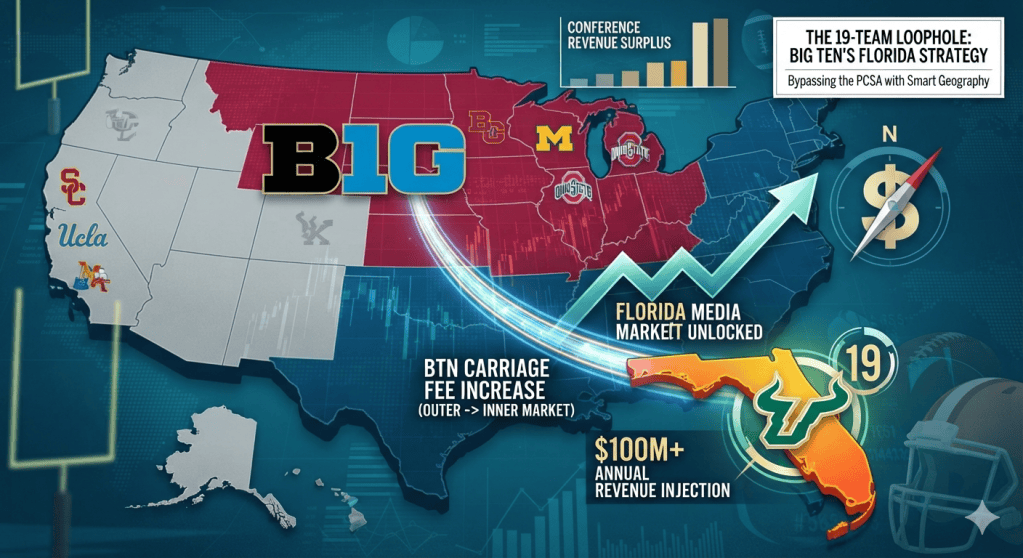
The landscape of college athletics is on the brink of structural lockdown [Protect College Sports Act (PCSA)]. Under the proposed framework of the bipartisan Protect College Sports Act (PCSA), college football expansion faces a radical new governing rule: any school electing to break away from a power conference must endure a mandatory five-year period of competitive and financial independence before it can officially join a new home.
For the Big Ten Conference, this “five-year exile” rule would effectively freeze out targeted tier-one acquisitions like Florida State or Clemson, whose ongoing legal battles to leave the ACC would result in a devastating, multi-year revenue blackout. Furthermore, with the PCSA drafting a strict 19-member team cap per conference, the Big Ten, currently sitting at 18 members, finds itself with exactly one remaining expansion slot to deploy.
Yet, sports media economics and a specific structural loophole in the PCSA have opened a backdoor. The five-year independent penalty is designed to penalize Power Conference defectors; it does not restrict Group of Five (G5) programs from jumping up. By exploiting this distinction, the Big Ten has a masterstroke arbitrage play waiting on its board: adding the University of South Florida (USF) Bulls.
Triggering the “Inner Market” Windfall
On paper, USF lacks the blue-blood football pedigree of a traditional blue-chip brand. In the economy of modern sports television, however, geography dictates valuation.
Florida currently boasts an active pay-TV ecosystem of roughly 6.5 million subscribers across cable, satellite, and live-streaming virtual providers (such as YouTube TV and Hulu + Live TV). Because the Big Ten currently features zero in-state programs, the Big Ten Network (BTN) is classified by distributors as an “outer market” channel, commanding a nominal carriage fee of roughly $0.15 per subscriber, per month.
The moment USF officially joins the Big Ten, everything changes. Under long-standing contracts between Fox/BTN and major television distributors (including Comcast Xfinity, Charter Spectrum, and DirecTV), the addition of an in-state university legally flips Florida from an “outer market” to an “inner market.”
This reclassification triggers an immediate contractual rate hike. Distributors operating within an inner market must pay an escalated in-network rate, typically ranging from $1.25 to $1.50 per subscriber, per month, to carry BTN.
The mathematical reality of this shift is immense:
- Current Baseline: 6.5M subscribers × $0.15/month = $975,000/month
- New In-Market Scale: 6.5M subscribers × $1.30/month = $8,450,000/month
- Net Monthly Growth: +$7,475,000
- Total Annual Unlocked Revenue: ~$89.7 Million to $100+ Million
Purely by placing a flag in the Tampa media market (the nation’s 11th largest), the Big Ten contractually forces Florida’s pay-TV infrastructure to inject roughly $100 million of automated, recurring annual revenue directly into the network’s ecosystem.
The $20 Million Reduced-Share Arbitrage
While the addition of USF generates immediate top-line revenue, the true genius of the play lies in how the Big Ten can structure the university’s entry payout.
A full-share Big Ten member commands an annual media rights payout hovering around $75 million. For a program transitioning out of the American Athletic Conference (AAC), receiving a full share on day one is highly unrealistic and financially unnecessary. Instead, the Big Ten can onboard USF at a heavily reduced starting rate of $20 million per year, paired with a conservative 10-year escalation ramp to reach full integration by the late 2030s.
This creates a massive, immediate financial surplus for the conference’s existing membership:
New In-State Revenue: $100M – USF initial payout $20M = +$80M annual surplus
Over the course of a 10-year integration runway, this rolling delta between the newly extracted Florida carriage fees and USF’s restricted media allocation generates a staggering $422.5 million in total net surplus profit for the Big Ten. When divided evenly among the conference’s other 18 member institutions, every school receives an automatic, multi-million-dollar annual dividend without altering their current travel schedules or media properties.
A 10-year escalation ramp starting at $20 million allows the Big Ten to generate an even larger financial cushion while successfully onboarding the USF Bulls.
Assuming a baseline full share payout of $75 million in 2029 (increasing at a standard 4% annual media inflation rate), here is how the revised $20 million onboarding model tracks over the decade against Florida’s $100 million in newly unlocked network carriage fees:
USF 10-Year Big Ten Media Payout Schedule ($20M Base)
| Academic Year | Big Ten Full Share Payout | USF Payout Share (%) | USF Actual Payout | Unlocked Conference Surplus |
|---|---|---|---|---|
| (2029) | $75M | 26.7% | $20M | +$80M |
| (2030) | $78M | 38.0% | $29.6M | +$70.4M |
| (2031) | $81.1M | 48.4% | $39.3M | +$60.7M |
| (2032) | $84.4M | 58.0% | $48.9M | +$51.1M |
| (2033) | $87.7M | 66.7% | $58.6M | +$41.4M |
| (2034) | $91.2M | 74.7% | $68.2M | +$31.8M |
| (2035) | $94.9M | 82.0% | $77.8M | +$22.2M |
| (2036) | $98.7M | 88.6% | $87.5M | +$12.5M |
| (2037) | $102.6M | 94.6% | $97.1M | +$2.9M |
| (2038) | $106.7M | 100.0% | $106.7M | $0M |
Key Strategic Impacts of the $20M Starting Point
- Expanded Cumulative Surplus ($366.3M): Over the 10-year span, the gap between the new in-state revenue and USF’s payout scales up to a staggering $366.3 million in net surplus profit.
- The Year 10 Adjustment: In Year 10, when USF achieves full-share parity, their payout slightly exceeds the localized $100 million network fee tier by $6.7 million. However, this minor deficit is completely neutralized by the $366.3 million in bankrolled profit accrued during the previous nine years.
- The Existing School Dividend: Dividing the rolling surplus evenly means the other 18 members take home a larger immediate reward, netting roughly $4.4 million in pure profit per school in Year 1 alone just for adding USF to the league.
The Pro Rata Blackout: Why the Big Ten’s Missing Clause Forces Early Expansion
Unlike the ACC, BIG12 or the SEC, the Big Ten does not have a pro rata clause written into its media rights contracts. When the conference expands, network partners like Fox, CBS, and NBC are not contractually obligated to automatically increase their payouts to cover the cost of new schools.
Because adding a school during the middle of a contract cycle would normally dilute the financial shares of existing members, the Big Ten must use a specific, high-leverage timeline to make your USF strategy work. The conference must expand 1 to 2 years before the master contracts expire in 2030.
The Financial Gridlock of No Pro Rata
Because the Big Ten lacks an automatic network multiplier, adding any school mid-cycle means the existing $7.8 billion TV pie does not grow by a single dime from primary broadcast inventory.
- The Expansion Penalty: If the Big Ten gave a new school a full share mid-contract, every existing university’s payout would instantly drop to fund the new addition.
- Why USF at $20M Solves This: Because the conference cannot get a pro-rata bump from Fox or CBS on day one, USF’s initial $20 million onboarding payout is funded entirely by the newly unlocked Big Ten Network (BTN) “inner market” carriage fees.
As established, flipping Florida’s 6.5 million pay-TV subscribers to in-state rates generates roughly $100 million in brand-new annual revenue, money that flows strictly through separate BTN distribution agreements, completely bypassing the frozen, non-pro-rata master contracts.
The 1-to-2-Year Runway (Why 2028/2029 is the Forced Window)
By adding USF in 2028 or 2029, the Big Ten executes a classic sports media “squeeze play” on network distributors:
[2028-2029: THE PRE-NEGOTIATION COMPRESSION] │ ├── 1. USF enters at $20M (Funded by new $100M BTN in-state fees) ├── 2. 6.5M Florida households are converted to B1G "Inner Market" accounts └── 3. Florida becomes a permanent, legally verified part of the B1G footprint │[2029-2030: THE MASTER RENEWAL CONTRACT] │ └── Fox, CBS, and NBC MUST negotiate the next multi-billion dollar master deal using Florida as a baseline requirement, forcing a massive pro-rata bump.
- Locking the Footprint Before Negotiations: The Big Ten cannot wait until the new contract is signed in 2030 to add USF. If they wait, networks will price the 2030 contract based on an 18-team footprint. The conference must add USF at least 12 to 24 months before the contract ends. This forces the networks to calculate the baseline value of the next multi-billion dollar deal using the entire state of Florida as a permanent asset.
- The “Look-Back” Valuation: When Fox, CBS, and NBC sit down in 2029 to bid on the next decade of Big Ten rights, they will look back at actual viewership data from the preceding two seasons. Having USF already in the conference gives the Big Ten concrete, high-rating broadcast numbers in Miami, Tampa, and Orlando to leverage during negotiations.
By utilizing this timeline, the Big Ten turns its lack of a pro rata clause into an intentional trap for networks. USF acts as a self-funding asset via BTN subscriber rate hikes for the first two years. Then, when the master television contracts are up for renewal, the networks are forced to absorb USF’s long-term escalation ramp at an amplified, premium valuation.
Institutional Alignment: The AAU Factor
Beyond the immediate financial rewards, USF fits the rigid institutional profile demanded by Big Ten university presidents. The conference famously mandates that its members (with the historical exception of Nebraska) maintain membership in the prestigious Association of American Universities (AAU) to foster elite academic and research collaboration.
USF’s official election into the AAU cleared the single biggest hurdle preventing the university from participating in previous realignment cycles. By joining the Big Ten Academic Alliance, USF unlocks access to shared federal research grants and institutional data grids that vastly exceed the value of athletic department budgets. Concurrently, USF’s ongoing construction of its state-of-the-art on-campus stadium provides the physical infrastructure necessary to host elite national programs under prime-time television spotlights.
If the PCSA passes into federal law, it will fundamentally close the front door on standard power-to-power conference raiding. Yet, by leveraging the 19th slot loophole with a rising, AAU-accredited G5 program, the Big Ten can execute a calculated geographic expansion. A reduced-share entry model for USF secures a permanent foothold in Florida, insulates the conference against future distribution challenges, and extracts a guaranteed $100 million annual premium from the Florida market, via BigTen Network, turning a restrictive federal law into an immediate financial windfall.


 The Ramblin Roundup
Leave a comment