
By Luke Fletcher | Fort Collins, Colorado
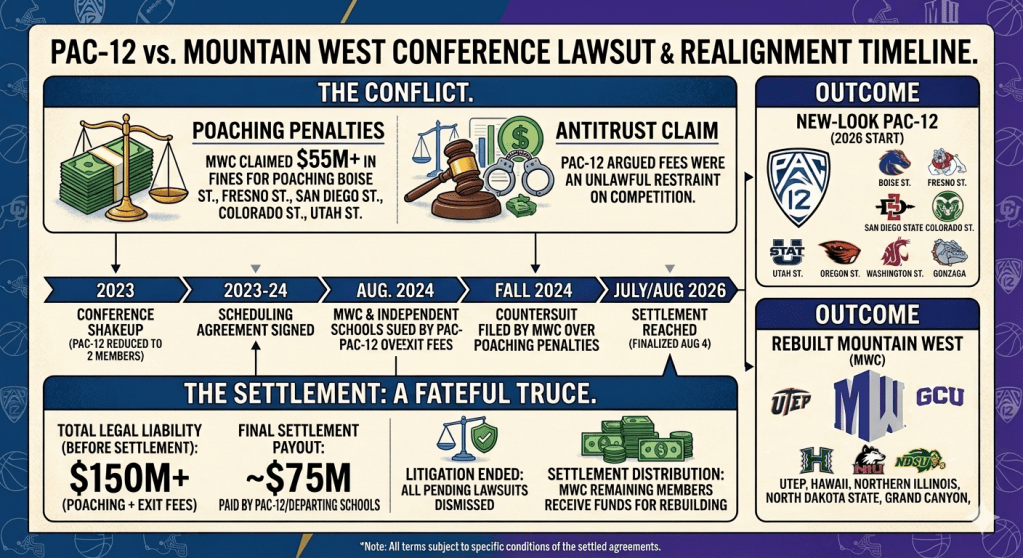
For nearly two years, the Pac-12 and Mountain West have been locked in a battle over financial disputes. This saga included lawsuits, accusations, and a maze of legal jargon that could confuse even the most passionate college football fans. But now, it seems we finally have a resolution. The total cost to settle this ongoing conflict is around $75 million. This amount will cover the exit fees for five schools; Boise State, San Diego State, Fresno State, Colorado State, and Utah State; each contributing about $10 million, which adds up to roughly $50 million. On the other hand, the Pac-12 will chip in about $25 million to resolve the poaching-fee issue related to a scheduling agreement made after the previous Pac-12 disbanded. So, when you do the math, $50 million plus $25 million equals about $75 million to put an end to the lawsuits and let everyone move forward. Interestingly, both sides might walk away feeling like they came out on top.
Remember How Strange This All Started
Looking back at the summer of 2023, the Pac-12 wasn’t just going through a rough patch; it was falling apart. With USC and UCLA making the jump to the Big Ten, Oregon and Washington soon followed suit, while Arizona, Arizona State, Colorado, and Utah opted for the Big 12. Meanwhile, Stanford and Cal found themselves in the Atlantic Coast Conference, a move that still feels bizarre no matter how often it’s mentioned. This left Oregon State and Washington State as the last two standing in a conference that had been around for over a hundred years, desperately in need of games, TV slots, and most importantly, time. The Mountain West stepped in, offering a scheduling agreement for the 2024 season that would allow the two remaining Pac-12 teams to play against Mountain West opponents while they figured out their next steps. However, the Mountain West wasn’t oblivious to the potential risks; they included clauses in the contract to protect themselves from any poaching by the Pac-12. But then, in a twist of fate, the Pac-12 did just that, snatching up schools like Boise State, Colorado State, Fresno State, San Diego State, and even Utah State. What started as a simple scheduling deal quickly escalated into a full-blown conference realignment battle.
The Original Bill Was Much Bigger
The $75 million settlement is significant because it highlights the Mountain West’s stance that its bylaws and scheduling agreement justified a much larger financial claim. According to these bylaws, a school leaving the conference could face an exit fee that amounts to three times the average annual distribution, which former FOX Sports Networks president Bob Thompson estimates to be around $6 million per school. This means that each departing school could potentially owe about $18 million, and with five schools leaving, the total could soar to nearly $90 million in exit fees alone. On top of that, the Pac-12 faced its own issues, as the scheduling agreement included penalties for poaching that could escalate to about $55 million if five Mountain West schools were taken. When you combine these figures, the Mountain West’s potential claims could reach around $150 million. This discrepancy between what the Mountain West thought it was owed and what the Pac-12 believed it should pay was substantial, essentially equating to the annual budget of an entire athletic department.
Instead, They Met Somewhere in the Middle
The five schools that are leaving are now on the hook for about $10 million each, which is still a hefty sum but significantly less than the original $18 million. For Boise State, San Diego State, Fresno State, Colorado State, and Utah State, this settlement nearly halves their expected exit costs. On the flip side, the Pac-12 is looking at a potential penalty of around $25 million instead of the full $55 million, which also represents a similar reduction. When you do the math, it adds up: five schools at $10 million each totals $50 million, plus the Pac-12’s $25 million brings the grand total to about $75 million. In the end, after all the legal wrangling, everyone ended up making concessions and dropped their lawsuits.
Bob Thompson Wasn’t Far Off
There’s an intriguing twist in the situation. Before the final settlement was revealed, Bob Thompson provided a helpful perspective on how things might play out. He pointed out that, based on past disputes, a settlement around 55 cents on the dollar would be quite reasonable. So, if you consider about $150 million in claims, that would translate to a settlement of roughly $82.5 million. However, the actual figure we’re looking at is around $75 million, which is even lower than that of his estimate. This is significant because, regardless of opinions on the merits of reviving the Pac-12, it’s hard to deny that the conference has notably improved its financial standing through this settlement. The Pac-12 didn’t come out on top by paying nothing; instead, it managed to reduce a potentially massive expense to a much more manageable amount.
And That’s Where the Pac-12 Probably Feels Pretty Good
Consider the perspective of a university president for a moment, setting aside the usual debates and logos. If a shift from the Mountain West to the Pac-12 could bring in an extra $3 to $4 million each year in media revenue, you’d be looking at a recovery period of about five to six years with an $18 million exit fee. That’s quite a wait to see any real profit from the move. However, if the exit fee is around $10 million, you might only need about three years to break even, depending on how media distributions and other costs pan out. This changes the financial equation significantly. While the settlement doesn’t guarantee that the Pac-12 will successfully rebuild, it does lower the bar for what’s needed in terms of TV viewership, sponsorships, and postseason opportunities. That’s definitely a positive shift.
Don’t Shed Any Tears for the Mountain West
This story takes an intriguing turn as the Mountain West finds itself in a surprisingly advantageous position despite the Pac-12’s financial struggles. Instead of walking away empty-handed, the Mountain West has managed to create a significant cash pool from the departures of its teams. This means that the schools that chose to stay are set to benefit financially, with an initial distribution of $61 million expected to yield some hefty checks. For instance, UNLV and Air Force are each slated to receive nearly $15 million, while Nevada, New Mexico, San Jose State, and Wyoming will get around $7 million each. Even Hawaiʻi will see a payout of about $3 million. This influx of cash is a game-changer, providing funds that can be allocated to athlete revenue sharing, facility upgrades, coaching staff, recruiting efforts, travel, and other essential needs. So, while the Mountain West may have lost some big-name football programs, it certainly didn’t do so without a financial benefit.
The Mountain West isn’t just raking in exit fees from schools that are leaving; it’s also cashing in on entry fees from new schools joining the conference. A prime example is North Dakota State, which is set to pay a hefty $12.5 million entry fee for football, including a $7 million payment due by July 1, 2026, followed by five annual installments of $1.1 million. Northern Illinois is also in the mix, revealing to its Board of Trustees that it will contribute around $2 million over six years to join the league. That adds up to a total of $14.5 million in known entry fees from just these two schools. While the financial details for UTEP, Grand Canyon, and UC Davis aren’t fully disclosed, if they are also paying significant entry fees, the Mountain West’s financial gains from realignment could be even more substantial. So, when people say the Mountain West “lost” $75 million compared to its initial claims, it doesn’t capture the full picture; the conference is actually generating revenue from both departing and incoming schools and will have collected north of $100 million when all has been collected.
It’s clear that not all the funds are just sitting idle in a conference bank account; however, that’s not the main takeaway here. The real story is how the Mountain West transformed what seemed like a dire situation into a major financial overhaul. Just a year back, the focus was on whether the conference could even keep going. Now, the discussion has shifted to how it will allocate tens of millions of dollars while bringing in new members. That’s quite an impressive shift.
So Who Won?
This is where college football fans often find themselves in heated debates. Pac-12 supporters will argue that the conference significantly lowered both exit fees and penalties for poaching, and they have a valid point. On the flip side, Mountain West fans can highlight that their conference secured tens of millions in revenue, rewarded its current members, and welcomed new schools with additional entrance fees, which is also a fair argument. This makes it hard to identify a clear loser in this situation. The Pac-12 achieved a more affordable way forward, while the Mountain West gained financial stability. The schools that left found certainty in their decisions, the ones that stayed received financial rewards, and the new Mountain West members gained entry into a well-established FBS conference. Everyone made sacrifices, but everyone also walked away with something valuable. That’s often the hallmark of a solid settlemen
The Strangest Part? They Still Share the Same TV Neighborhood
Despite all the legal battles, membership shifts, and debates over which conference is paving the way for the future, the Pac-12 and Mountain West aren’t stepping into entirely different broadcasting realms. They both have significant media partnerships, with CBS Sports and The CW on board for their new configurations starting in 2026. The Pac-12’s deal includes CBS Sports, The CW, and USA Network, while the Mountain West sticks with CBS Sports and FOX Sports while they add The CW. This overlap makes the realignment saga even more intriguing. After a whirlwind of lawsuits, a hefty $75 million in settlement transactions, and five schools switching conferences, many teams will still be showcased on the same networks. For instance, a Boise State game could air on The CW, just like a UNLV matchup, while San Diego State might be featured on CBS Sports Network alongside Nevada. The main distinction lies in the third media partner; the Pac-12 opted for USA Network, adding another cable platform, whereas the Mountain West continues its long-standing relationship with FOX. This results in a surprisingly similar television landscape for both conferences, raising the question of how different they will appear to the average viewer. The Pac-12 is banking on its brand lineup, featuring teams like Boise State, Oregon State, and San Diego State, to attract more lucrative media deals, but the Mountain West isn’t fading into obscurity either, as it retains substantial national exposure through CBS Sports, FOX, and The CW until 2031.
The Real Missed Opportunity
There’s definitely a part of this whole situation that feels a bit sad. Just think about how much money, legal wrangling, and pride could have been saved if Oregon State and Washington State had teamed up with the Mountain West from the start. What if the conferences had pulled off a reverse merger, blending the Mountain West’s members with the remaining assets and NCAA tournament units of the Pac-12? Instead of shelling out millions to shift schools between Western conferences, they could have combined their strengths. Of course, maybe that wasn’t feasible politically, or perhaps the Pac-12 brand was just too precious to let go. It’s also possible that Mountain West leaders weren’t keen on losing their influence, and Oregon State and Washington State thought they could create something even better. It’s likely a mix of all these factors, but it’s hard not to look at the outcome and ponder what could have been. In the end, it feels like Western college athletics spent two years just rearranging the deck chairs.
Now Comes the Part That Actually Matters
The excitement around the lawsuits has faded. Now, football needs to make sense of everything happening. The revamped Pac-12 includes teams like Oregon State, Washington State, Boise State, and others, with Gonzaga boosting its basketball profile. Meanwhile, the Mountain West has adapted by adding NIU, GCU, North Dakota State, and a few more, with Hawaii joining as a full member. Both conferences now face the challenge of proving their plans are effective. Can the Pac-12 create enough media value to justify its expenses? And can the Mountain West leverage its financial gains and new teams for lasting success? These questions are far more compelling than the legal battles, which seem to be winding down. The financial implications are clear, with a hefty $75 million bill that everyone has agreed to cover. Now, it’s time to see if all this realignment was worth the investment.

 The Ramblin Roundup
Leave a comment