
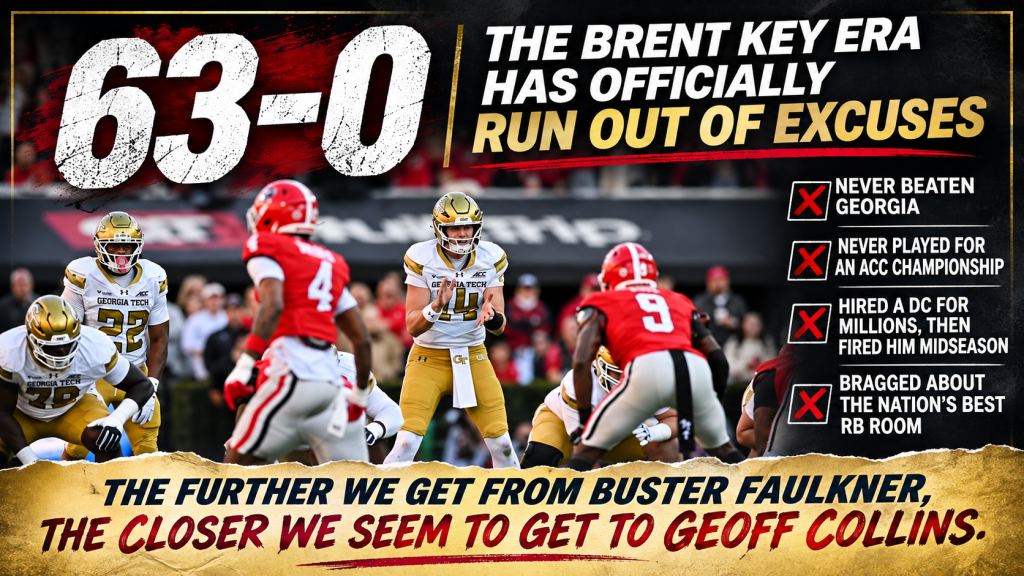
The further Georgia Tech gets from Buster Faulkner, the closer it seems to get to Geoff Collins.
There are losses, there are embarrassing losses, and then there is what Georgia Tech delivered Saturday in Clean, Old-Fashioned Hate. Sixty-three unanswered points against your biggest rival. No touchdowns. No field goals. No indication that the gap between the two programs is closing. Instead, Georgia Tech delivered a humiliating performance that should force everyone associated with the program to confront some uncomfortable questions.
This wasn’t simply a talent discrepancy. Georgia Tech has faced talent discrepancies for decades. It was an indictment of the direction of the football program under Brent Key.
Was Brent Key Ever the Architect of Georgia Tech’s Success?
It’s time to take a serious look at whether Brent Key built Georgia Tech’s success or benefited from an exceptional group around him. Buster Faulkner led the offense, Haynes King brought leadership and playmaking, and the assistant coaches helped develop and recruit players.
That group came together through a chain of decisions: former AD J Batt connected Key with Faulkner, who helped shape the staff and, with Chris Weinke, brought QB Haynes King to Georgia Tech. That raises a fair question about how much of the turnaround belonged to Key himself. When Faulkner and his staff left, Key had a chance to show he could replace their contributions and sustain the program’s progress. Instead, Georgia Tech’s dramatic regression culminated in a 63–0 loss to its biggest rival. A head coach must do more than oversee a talented roster; he must hire well, develop coaches, and build a culture that lasts. So was Key the architect of Georgia Tech’s resurgence, or the general contractor executing someone else’s design? The results since Faulkner’s departure make that question harder to ignore.
The Resume Doesn’t Match the Reputation
For all the praise Brent Key has received, consider what he has actually accomplished as Georgia Tech’s head coach:
- Never beaten Georgia.
- Never played for an ACC Championship, much less won one.
- Committed millions to a defensive coordinator from Memphis, only to fire him midway through the season.
- Lost numerous assistant coaches following the previous season.
- Proclaimed that Georgia Tech had the best running back room in the country, only to oversee an offense that looked like a reboot of the Geoff Collins era.
- Now owns a humiliating 63–0 defeat against Georgia.
At what point does the reputation have to be supported by the results? Being a Georgia Tech alumnus, understanding the rivalry and delivering passionate speeches about toughness are admirable qualities. But none of them substitutes for competent football.
You don’t get points on the scoreboard for loving your alma mater.
Accountability Cannot Stop at the Head Coach’s Office
Key has fired assistant coaches, but who hired them?
The players aren’t performing, but who recruited and developed them?
The offensive line has struggled. Isn’t that Key’s area of expertise?
The defense has been a disaster. Who chose to invest in the defensive coordinator?
A head coach can’t claim credit when things go right and dodge accountability when they fall apart. You can’t keep firing the assistants you hired and blaming the players you recruited while expecting scrutiny to stop short of your own office.
Eventually, the common denominator is impossible to ignore.
Aaron Philo’s Departure: When Loyalty to the Coordinator Outweighs Loyalty to the Program
One of the most revealing moments of the Brent Key era may be Aaron Philo’s decision to follow offensive coordinator Buster Faulkner to Florida instead of staying at Georgia Tech.
NIL is often blamed when players leave, but reports say Georgia Tech was willing to match Florida’s offer. If money wasn’t the deciding factor, what was?
In college football, relationships matter. Players build trust with the coaches who recruit, develop and work with them every day. Philo and others choosing to follow Faulkner raise questions about where those bonds were strongest at Georgia Tech.
When a promising quarterback leaves despite reportedly comparable financial terms, and the chance to become the face of the program, it warrants attention. It also sharpens a broader question about Key’s leadership: Was Georgia Tech’s offensive success driven by Key, or by the relationships, recruiting and development Faulkner and his staff brought to the program?
Coordinators and assistants leave; that’s part of college football. But when talented players follow them, even without a clear financial incentive (Tech was willing to match the NIL), the losses deserve closer scrutiny. Georgia Tech may have lost more than its offensive coordinator, it may have lost a key part of the foundation behind its resurgence. After a 63–0 defeat to Georgia, the cost of those departures feels all the more stark.
The Geoff Collins Comparisons Are Becoming Unavoidable
Remember the Geoff Collins era’s recruiting hype, promises of cultural change and nonstop optimism about building something special, even as the losses piled up?
Fans were told Brent Key would bring a different kind of program: disciplined, physical and fundamentally sound. Yet questionable decisions, underdeveloped talent and disappointing performances are again exposing the gap between preseason promises and what happens on the field.
When a coach touts the nation’s best running back room, then goes scoreless in a rivalry game, the comparisons are hard to avoid.
Different coach, different slogans, but the results feel all too familiar.
Georgia Tech Deserves Better
No one reasonably expects Georgia Tech to match Georgia’s money, recruiting reach or roster depth. But expecting Tech to compete is fair. Paul Johnson proved the Yellow Jackets could beat Georgia, contend for conference titles and win an Orange Bowl despite major disadvantages. Brent Key’s benchmark shouldn’t be merely outperforming Geoff Collins, that’s far too low for a program with Tech’s history. He should be judged on whether he can contend for championships, develop players, beat rivals and build a lasting program. Saturday’s performance offered little reason for optimism.
The Question Nobody Wants to Answer
What exactly have you seen from Brent Key, independent of Buster Faulkner, Haynes King and the numerous assistant coaches who departed last season, that gives you confidence he can build and sustain a winning football program?
Not what you hope he’ll become, how much he loves Georgia Tech or what he achieved with a staff that’s no longer there; what has he done since those departures to earn continued confidence in his leadership?
Georgia Tech can’t mistake loyalty for leadership, passion for competence or past success for future promise. A 63–0 loss to your biggest rival shouldn’t be brushed off as a bad day. It should force the entire program to reckon with where it’s headed.
Brent Key was supposed to be the antidote to the Geoff Collins era. Instead, the further we get from Buster Faulkner, the closer we seem to get to Geoff Collins.
And that should terrify every Georgia Tech fan. Go Jackets!


Leave a Reply