
By Luke Fletcher | Atlanta, Georgia
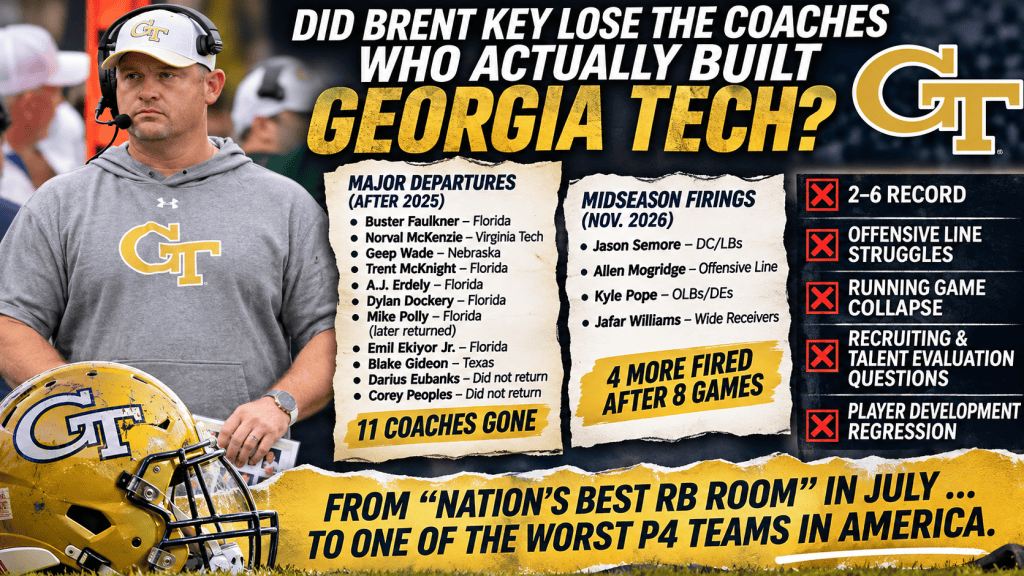
From offseason hype to midseason firings, Georgia Tech’s 2026 collapse raises serious questions about recruiting, player development, coaching decisions, and accountability.
Georgia Tech entered the 2026 season expecting to keep improving under Brent Key, but eight games in, the Yellow Jackets were 2–7 and struggling on both sides of the ball. The bigger concern is how quickly the team seemed to lose the identity, physicality, and player development that had fueled its progress. That raises a tough question: did Key build the program’s recent success, or did he benefit from a strong coaching staff he couldn’t replace?
The Great Coaching Exodus
Following the 2025 season, Georgia Tech experienced an extraordinary amount of coaching turnover. Eleven coaches and support staff members departed or did not return.
| Coach | Position | Destination |
|---|---|---|
| Buster Faulkner | Offensive Coordinator | Florida |
| Norval McKenzie | Running Backs | Virginia Tech |
| Geep Wade | Offensive Line | Nebraska |
| Trent McKnight | Wide Receivers | Florida |
| A.J. Erdely | Assistant Quarterbacks | Florida |
| Dylan Dockery | H-Backs | Florida |
| Mike Polly | Assistant Offensive Line | Florida |
| Emil Ekiyor Jr. | Offensive Analyst | Florida |
| Blake Gideon | Defensive Coordinator | Texas |
| Darius Eubanks | Linebackers | Did not return |
| Corey Peoples | Defensive Backs | Did not return |
Losing so much institutional knowledge, recruiting experience, and player-development expertise in one offseason would test any program. The bigger question is whether Georgia Tech recognized just how much it was losing. Were Faulkner, McKenzie, Wade, and the other departing assistants the ones who found overlooked talent, developed players, and built the offensive identity that made the Yellow Jackets competitive? Based on the 2026 results, it looks like something essential left with them.
From the Nation’s Best Running Back Room to Offensive Dysfunction
Nothing captures Georgia Tech’s disappointing season better than the gap between preseason optimism and the reality by November. In the offseason, the Yellow Jackets’ running back room was touted as one of the nation’s best groups. But eight games in, the offense has struggled to run consistently, protect its quarterback, and deliver the physical style Brent Key promised. Questions about the roster, the offensive line, and the coaching transition ultimately point back to Key. Most troubling is the decline up front: despite building his reputation on developing linemen, Key has watched the unit falter since Geep Wade left for Nebraska and Allen Mogridge took over. For a coach committed to physical football and controlling the line of scrimmage, that’s hard to explain.
Eight Games Later, Four More Coaches Are Gone
As if the offseason departures weren’t enough, Key made another dramatic series of coaching changes in November 2026.
Four assistants were dismissed after just eight games:
- Jason Semore – Defensive Coordinator/Linebackers
- Allen Mogridge – Offensive Line
- Kyle Pope – Outside Linebackers/Defensive Ends
- Jafar Williams – Wide Receivers
Think about what that means. Georgia Tech lost 11 coaches and support staff members following 2025, and just eight games into the following season, four more assistants were dismissed.
That’s 15 coaching and support-staff departures or dismissals across two periods of extraordinary turnover. At some point, this stops looking like ordinary staff restructuring and starts looking like a program struggling to establish continuity, evaluate coaching talent, and maintain a consistent identity.
Firing assistants can be necessary. Sometimes changes are required to correct poor performance. However, when the head coach hires the replacements, oversees their preparation, and then fires several of them before their first season is complete, the accountability cannot stop with the assistants.
Who Was Really Evaluating and Developing the Talent?
A key question behind Georgia Tech’s decline is whether it lost more than just its coordinators. Strong programs don’t simply recruit highly rated players; they find athletes who fit their systems, develop them, and build an identity that lasts beyond any one coach. Under Faulkner, the offense gained a creative style centered on quarterback development and an effective running game. Wade’s offensive line proved it could hold its own against talented opponents, while McKenzie helped develop the running backs. Now, Georgia Tech seems to be struggling in the very areas where it had made progress. That doesn’t mean the departing assistants were solely responsible for the program’s success, but it does raise questions about how much their recruiting judgment, coaching, and player development contributed.
Did Georgia Tech lose the people who knew how to identify and develop the right players for its system? If so, why wasn’t Brent Key able to replace that expertise?
The Head Coach Must Own the Results
No one should doubt Brent Key’s passion for Georgia Tech or his commitment to rebuilding the football program. But loyalty alone can’t replace strong leadership, recruiting, talent evaluation, and coaching. As head coach, Key is responsible for building his staff, defining the program’s identity, assessing the roster, and preparing the team to compete. He deserves credit for Georgia Tech’s progress, but he must also own the sharp decline that followed. If a new staff is struggling, it’s fair to question the person who hired them, and how the team lost so much momentum after one offseason of major roster changes.
The Question Georgia Tech Must Answer
Georgia Tech fans backed Brent Key because they believed he understood the program, prized physical football, and could make the Yellow Jackets competitive again. But the 2026 season has raised troubling questions about his ability to assess coaching talent, preserve continuity, and build for the long term. Eleven staff departures were followed by a disappointing season and four more midseason firings. The offensive line has slipped, the running game has faltered, the defense has struggled, and the team’s identity feels increasingly unclear. Was Key the driving force behind the program’s progress, or did he benefit from assistants who handled much of the recruiting, evaluation, and player development? It’s a question worth asking. If those coaches were central to Georgia Tech’s success, their departure may have cost the program more than a few staff members, it may have erased the foundation that made the team competitive. After another round of firings, fans have every reason to wonder whether Key can rebuild it.
You cannot continually fire the coaches you hired, blame the players you recruited, and expect accountability to stop before it reaches the head coach.
At some point, the responsibility belongs to the person running the program, and for Georgia Tech, that person is Brent Key. Go Jackets!


Leave a Reply