
By Luke Fletcher | Ft. Collins, Colorado
A new identity, the same passion that has defined Mountain West football in the past. On July 1, 2026, the Mountain West officially turns the page. Gone is the familiar “At the Peak” branding that helped define the conference for nearly a decade. In its place comes a new identity, Built Bold, a philosophy designed to embrace change rather than fear it. The rebrand arrives as the conference undergoes its biggest transformation since its formation in 1999, welcoming new members while saying goodbye to several longtime rivals. Conference officials say the new identity reflects bold leadership, innovation, perseverance, and a commitment to shaping the future of collegiate athletics.
For many fans, the first question has been simple: Can the new Mountain West maintain the same level of passion after losing so many traditional rivalries?
The answer is yes.
In fact, the conference may be more rivalry-driven than many realize. While the departures of Boise State, Fresno State, Colorado State, San Diego State, and Utah State undoubtedly close one chapter of Mountain West history, they also shine a brighter spotlight on rivalries that have quietly defined the league for decades.
Some feature iconic trophies. Others are built on geography, history, military tradition, or cultural connections that stretch back more than a century. Together, they perfectly represent what the Mountain West hopes Built Bold becomes, a conference that respects its history while confidently building its future. Below we rank the top Rivalry games for 2026.
1. Nevada vs. UNLV — The Battle for the Fremont Cannon
If one rivalry embodies the spirit of the Mountain West’s new Built Bold era, it’s the Battle for the Fremont Cannon. For more than five decades, Nevada and UNLV have battled not only for the state’s most coveted prize but also for bragging rights across the Silver State. Since the rivalry began in 1969, the annual showdown has grown into one of college football’s premier trophy games, carrying significance that extends well beyond the conference standings.
The Fremont Cannon itself is unlike any other trophy in college athletics. Built in 1970 at a cost of $10,000, the replica Civil War cannon weighs an astonishing 545 pounds, making it the heaviest and most expensive rivalry trophy in college sports. Painted in the colors of the winning school each year, it has become one of the most recognizable symbols in the sport.
Ironically, the trophy exists because of a prank that never succeeded.
In 1965, a group of students and athletes from Nevada Southern—now UNLV—traveled to Reno with a rented trailer and a set of tools, hoping to steal a World War I cannon displayed on the University of Nevada campus. The group managed to move the cannon only about 25 feet before campus security intervened. Rather than pressing charges, Nevada officials laughed off the failed heist. The story eventually inspired UNLV’s first football coach, Bill Ireland, who proposed creating a traveling trophy to permanently commemorate the growing intrastate rivalry. For years, the Cannon wasn’t just displayed—it was fired.
Traditionally, the school in possession of the trophy loaded the cannon with paper wads and fired it after every touchdown during the rivalry game, creating one of college football’s most memorable traditions. That practice ended in 2000, when the Cannon was accidentally dropped during a postgame celebration and suffered significant damage. Although it has since been restored, it now serves strictly as a ceremonial trophy.
Nevada enters the 2026 season holding a 29-22 advantage in the all-time series, but regardless of records, the Battle for the Fremont Cannon has consistently delivered unforgettable moments and passionate crowds.
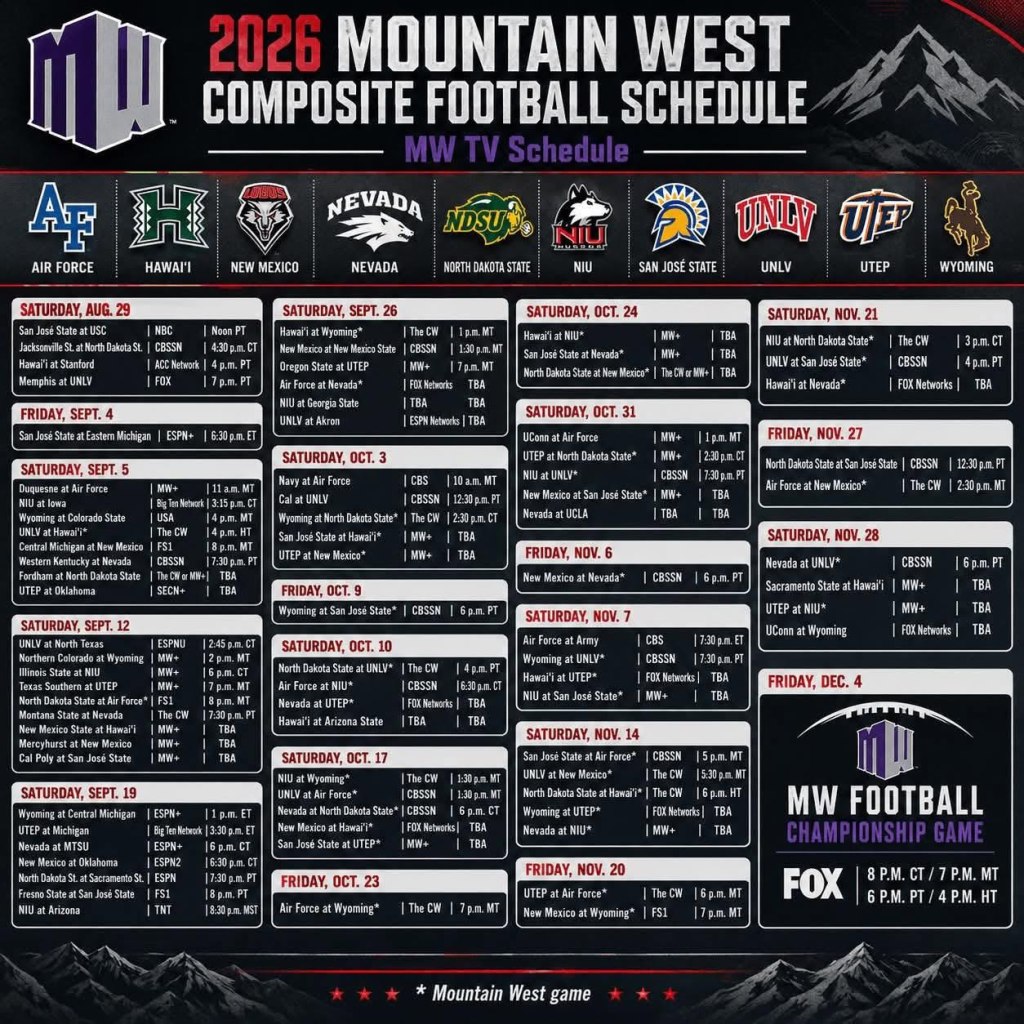
The 52nd Battle for the Fremont Cannon is scheduled for Saturday, November 28, 2026, and with the Mountain West entering its Built Bold era, there may not be a more fitting rivalry to showcase the conference’s future. It is the league’s flagship game, a matchup built on tradition, fueled by state pride, and carried forward by generations of players and fans.
Why it ranks No. 1
- College football’s heaviest rivalry trophy (545 pounds)
- The most expensive rivalry trophy ever built when introduced in 1970
- Began with a legendary failed campus prank in 1965
- Statewide rivalry dating back to 1969
- Nevada leads the all-time series 29-22
- Annual battle for Nevada bragging rights
- The signature rivalry of the Mountain West’s Built Bold era
2. New Mexico vs. UTEP — A Rivalry Returns Home
Conference realignment didn’t create the rivalry between New Mexico and UTEP.
It simply brought it back where it belongs. As the Mountain West enters its Built Bold era, few games better represent the conference’s vision than the return of one of the Southwest’s oldest football rivalries. After spending decades together in both the Border Conference and the Western Athletic Conference (WAC), the Lobos and Miners are once again conference opponents, rekindling a series that has produced nearly a century of memorable moments.
Separated by just 265 miles, Albuquerque and El Paso have long competed for regional pride, recruiting supremacy, and bragging rights across the Southwest. The proximity of the two schools has always fueled passionate fan bases, making every meeting feel bigger than just another game on the schedule.
The rivalry dates back to 1931, and the schools have met 80 times, with New Mexico leading the all-time series 44-33-3 entering the 2026 season. During their years together in the Border Conference and later the WAC, the annual matchup became one of the league’s premier rivalries. At one point, the Lobos rattled off 17 consecutive victories, though UTEP has enjoyed its share of memorable wins in recent decades. Several games still stand out in the rivalry’s history.
The 1982 showdown became one of the highest-scoring games in the series, showcasing the offensive firepower that often defined WAC football during that era. In 1997, the rivalry carried conference championship implications as New Mexico entered the season fresh off a trip to the inaugural WAC Championship Game. Powered by a physical rushing attack, the Lobos continued to establish themselves as one of the conference’s top programs during one of the rivalry’s most competitive periods.
More recently, UTEP has reminded New Mexico that nothing comes easy in this series. The Miners opened the 2014 season with a 30-21 victory in El Paso behind a dominant 247-yard rushing performance, while Ronald Awatt’s 117 rushing yards helped UTEP secure a 20-13 road victory in Albuquerque in 2021.
The next chapter begins on Saturday, October 3, 2026, when the schools meet in Albuquerque for the first Mountain West conference meeting of the Built Bold era.
Some fans believed New Mexico’s most natural conference rival would have been New Mexico State. Instead, the Mountain West reunited two programs whose rivalry already possesses everything a conference could want; history, geography, passionate fan bases, and decades of meaningful football. As the Mountain West writes its next chapter, few rivalries are better positioned to become a cornerstone of the conference’s future than New Mexico and UTEP. Sometimes the best new traditions are simply the oldest ones rediscovered.
Why it ranks No. 2
- One of the Southwest’s oldest rivalries
- 80 all-time meetings
- New Mexico leads the series 44-33-3
- Former Border Conference and WAC rivals reunited
- Only 265 miles separate the campuses
- Regional recruiting battle across New Mexico and West Texas
- Returns as a featured matchup in the Mountain West’s Built Bold era
3. Hawai’i vs. San José State — Dick Tomey Legacy Game
Some rivalries are built on geography. Others are fueled by decades of animosity. The rivalry between Hawai’i and San José State is different. It is built on history, respect, and one of the most remarkable legacies in college football, making it one of the Mountain West’s most meaningful annual matchups.
The series dates back to 1936, with the two programs meeting 47 times entering the 2026 season. San José State holds a narrow 24-22-1 advantage, a reflection of just how evenly contested the rivalry has remained over nearly nine decades.
The game’s modern identity was born in 2019, when the Mountain West introduced the Dick Tomey Legacy Trophy. Few coaches have left a greater impact on two conference programs than Tomey, who transformed Hawai’i into a perennial contender from 1977 to 1986 before later rebuilding San José State from 2005 to 2009. The annual trophy recognizes not only his coaching accomplishments but also the integrity, sportsmanship, and leadership he brought to both universities.
Long before the trophy existed, however, the rivalry had already secured a unique place in college football history. In December 1941, the San José State football team traveled to Honolulu to participate in the Shrine Bowl. Days later, the attack on Pearl Harbor changed everything. Stranded on the islands after commercial transportation was suspended, Spartan players spent nearly two weeks assisting the Honolulu Police Department and helping protect military installations until they were finally able to return home aboard the SS President Coolidge. No other rivalry in the Mountain West carries a story quite like it.
The games themselves have consistently delivered unforgettable moments. One of the series’ greatest contests came in 1990, when Hawai’i edged San José State 29-28 in a dramatic fourth-quarter comeback. Nearly four decades later, it remains one of the defining games in the rivalry’s history. The rivalry entered a new chapter on November 9, 2019, when the schools met for the first time with the Dick Tomey Legacy Trophy on the line. In a back-and-forth thriller, Hawai’i defeated the Spartans 42-40 in Honolulu to become the inaugural keeper of the trophy honoring one of the sport’s most respected coaches.
The competitiveness hasn’t faded in recent years. In 2022, San José State earned a hard-fought 27-14 victory in a defensive battle that showcased the physical style both programs have embraced during the Mountain West era. The latest chapter arrived on November 1, 2025, when the Spartans outlasted Hawai’i 45-38 in one of the most entertaining games of the college football season. The two offenses combined for more than 1,100 yards, with Hawai’i quarterback Micah Alejado throwing for 367 yards, but San José State answered behind a dominant rushing attack led by Steve Chavez-Soto, who scored three touchdowns to preserve the victory.
As the Mountain West enters its Built Bold era, this rivalry represents everything the conference hopes to become. It honors its past while continuing to produce meaningful games every season. It features one of the league’s most recognizable trophies, one of college football’s most respected coaching figures, and nearly 90 years of unforgettable history.
The 2026 edition of the Dick Tomey Legacy Game will be played in Honolulu and is scheduled for Saturday, October 3, 2026.
Why it ranks No. 3
- One of the Mountain West’s oldest rivalries (since 1936)
- Official Dick Tomey Legacy Trophy game
- San José State leads the all-time series 24-22-1
- Honors one of the most influential coaches in conference history
- Unique World War II connection following the attack on Pearl Harbor
- Features multiple classic games, including the 1990 thriller, the inaugural trophy game in 2019, and the 2025 offensive shootout
- Perfectly embodies the Mountain West’s Built Bold vision by celebrating tradition while continuing to create new memories
4. Air Force vs. Wyoming — A Rivalry Built on Toughness
Every conference has that one rivalry where records, rankings, and statistics seem to matter a little less once the ball is kicked off. For the Mountain West, that game is Air Force versus Wyoming.
As the conference enters its Built Bold era, few rivalries better represent its identity than this annual showdown. For nearly seven decades, the Falcons and Cowboys have built their reputations on toughness, discipline, and physical football. There are no gimmicks in this matchup—just two programs that pride themselves on winning at the line of scrimmage. The rivalry began in 1957, and entering the 2026 season, the teams have met 63 times, with Air Force holding a narrow 32-28-3 advantage. Throughout the years, the series has remained remarkably competitive, often featuring bruising rushing attacks, dominant defensive fronts, and games decided in the closing minutes.
Stylistically, the matchup has always been fascinating. Air Force’s nationally recognized triple-option offense consistently challenges Wyoming’s rugged front seven, while the Cowboys have traditionally countered with disciplined linebackers and physical defensive line play. The result is usually one of the hardest-hitting games on the Mountain West schedule. Several games have become part of conference lore.
In 1998, No. 23 Air Force edged No. 25 Wyoming 10-7 to capture the final Western Athletic Conference Championship, cementing one of the rivalry’s most significant moments. The series delivered another classic in 2012, when Air Force escaped with a dramatic 28-27 victory. The one-point thriller wasn’t just remembered for the finish, it also produced one of the rivalry’s most infamous moments when Wyoming head coach Dave Christensen confronted Air Force coach Troy Calhoun after the game in a heated exchange that made national headlines and underscored just how much this rivalry means to both programs.
Perhaps the most unforgettable comeback came in 2018. Trailing 27-14 with less than five minutes remaining on a snowy afternoon in Laramie, Wyoming looked finished. Instead, backup quarterback Tyler Vander Waal sparked one of the greatest rallies in school history, accounting for four touchdowns as the Cowboys scored 21 unanswered points in the final 4:32 to stun Air Force 35-27 before a delirious home crowd at War Memorial Stadium.
The rivalry continued to add another memorable chapter in 2025, when Air Force defeated Wyoming 24-21 in Colorado Springs. The Falcons sealed the victory by intercepting two fourth-quarter passes, stopping a late Wyoming comeback in another game that perfectly illustrated how evenly matched these programs have become. That competitive balance is exactly why this rivalry continues to thrive.
While other rivalries are built around trophies or state borders, Air Force and Wyoming have built theirs through decades of physical football, championship implications, and mutual respect earned between two programs that have consistently represented the best of Mountain West football.
As the conference embraces its Built Bold future, this rivalry remains one of its strongest foundations. Every meeting feels like a heavyweight fight, and more often than not, the outcome isn’t decided until the final possession. Air Force and Wyoming will play their 2026 college football matchup in Laramie on Friday, October 23, 2026.
Why it ranks No. 4
- One of the Mountain West’s longest-running rivalries (since 1957)
- Air Force leads the all-time series 32-28-3
- Consistently features championship implications
- Signature clash of Air Force’s triple-option offense against Wyoming’s physical defense
- Home to memorable moments, including the 1998 WAC Championship, Wyoming’s remarkable 2018 comeback, and the dramatic 2025 defensive finish
- Perfectly represents the toughness and competitive identity of the Mountain West’s Built Bold era
5. Hawai’i vs. UNLV (The Ninth Island Showdown)
No rivalry in the new Mountain West better reflects the conference’s unique geographic and cultural identity than the Ninth Island Showdown between Hawai’i and UNLV. The rivalry extends well beyond football.
Las Vegas has long been considered the “Ninth Island” by Hawaiians because of its large Hawaiian population and its popularity as both a vacation destination and a place to relocate. Thousands of Hawai’i residents now call Southern Nevada home, giving every meeting between the Rainbow Warriors and Rebels the feel of a home game for both fan bases.
The two programs first met in 1969 and have played 35 times, with Hawai’i holding a narrow 19-16 advantage entering the 2026 season. Recognizing the rivalry’s growing importance, the California Hotel & Casino, a Las Vegas landmark that has catered to Hawaiian visitors for decades, donated the Golden Pineapple Trophy in 2017. Since then, the annual winner has taken home one of college football’s most unique rivalry trophies.
The significance of the matchup was further cemented when the Mountain West transitioned to a single-division format in 2023. Hawai’i and UNLV were designated as one of the conference’s protected annual rivalries, ensuring the game would remain on the schedule every season regardless of future scheduling rotations.
Beyond the trophy, the rivalry has become a celebration of Hawaiian culture in Las Vegas. Thousands of Hawai’i fans regularly make the trip to Allegiant Stadium or Sam Boyd Stadium, creating one of the most festive atmospheres in the conference. The game has evolved into more than just a football contest, it’s an annual reunion for the large Hawaiian community living in Southern Nevada.
As the Mountain West enters the Built Bold era, the Ninth Island Showdown is positioned to become one of the conference’s marquee events. With both programs expected to compete for bowl games and conference championships, the annual battle for the Golden Pineapple should only continue to grow in importance. UNLV and Hawaii will face off in Honolulu in 2026 on Saturday, September 5, 2026.
Why it ranks No. 5
- Official Golden Pineapple Trophy rivalry
- One of the Mountain West’s protected annual rivalries
- Dates back to 1969
- Hawai’i leads the series 19-16
- Celebrates the unique connection between Hawai’i and Las Vegas
- Large traveling fan bases create a bowl-game atmosphere
- Increasing championship implications in the new Mountain West Built Bold era
6. Nevada vs. San José State
While it may not receive the national attention of the Fremont Cannon or the Dick Tomey Legacy Game, Nevada and San José State have quietly built one of the Mountain West’s oldest and most enduring rivalries.
The series dates all the way back to 1899, when Nevada defeated San Jose State 6-0 in Reno on Thanksgiving Day. The game’s lone touchdown came from Bob Brule, who famously crossed the goal line before tumbling into an irrigation ditch behind the end zone, with three San Jose State players following him into the water. More than a century later, it remains one of the most memorable stories in the history of either football program.
Entering the 2026 season, Nevada leads the all-time series 25-12-2, including a 55-10 victory over the Spartans at Mackay Stadium in November 2025. The Wolf Pack have also won six of the last ten meetings, underscoring how competitive the rivalry has remained in recent years.
Although the schools did not meet between 1901-1930 and again from 1949-1991, the rivalry has flourished since both programs became conference opponents. Nevada and San José State have competed in the same league continuously since 1992, first as members of the Big West Conference, later in the Western Athletic Conference (WAC), and since 2013 as Mountain West rivals.
The two universities also share remarkable institutional similarities. San José State, founded in 1857, is California’s oldest public institution of higher education, while the University of Nevada, Reno, founded in 1874, holds that distinction in Nevada. Their campuses are separated by approximately 250 miles, creating a natural regional matchup between two flagship public universities that have spent much of the past three decades competing against one another.
As the Mountain West enters the Built Bold era, Nevada and San José State become two of the conference’s cornerstone programs. With many of the league’s historic rivalries disappearing through realignment, this long-standing series takes on added significance and has the opportunity to become one of the defining annual matchups in the new-look conference. Nevada and Hawaii play on Saturday, November 21, 2026 in Reno, Nevada.
Why it ranks No. 6
- One of the oldest rivalries in Mountain West football (first played in 1899)
- Nevada leads the all-time series 25-12-2
- Shared conference history dating back to 1992
- Approximately 250 miles separate the campuses
- California’s oldest public university vs. Nevada’s oldest public university
- Historic Thanksgiving Day origin and memorable first-game story
- Important Mountain West’s legacy rivalries that can continue in the Built Bold era
7. Hawai’i vs. Wyoming (Paniolo Trophy)
The rivalry between Hawai’i and Wyoming may span nearly 3,400 miles, but it has become one of the Mountain West’s most distinctive traditions. Since first meeting in 1978, the Rainbow Warriors and Cowboys have played 29 times, with Wyoming holding a 17-12 advantage entering the 2026 season. While separated by geography, the two programs are connected by one of college football’s most unique rivalry trophies, the Paniolo Trophy.
The rivalry was born when Hawai’i joined the Western Athletic Conference and the teams met annually from 1978 through 1997. When Wyoming departed for the newly formed Mountain West in 1999, the annual series came to an end. It was renewed in 2013 when Hawai’i joined the Mountain West as a football-only member, restoring one of the conference’s most recognizable cross-Pacific rivalries.
The Paniolo Trophy symbolizes the shared cowboy heritage of both states. The word “Paniolo” is the Hawaiian term for cowboy, a tradition that dates back to the early 1800s when Mexican vaqueros introduced cattle ranching to the Hawaiian Islands. The original trophy featured a bronze cowboy on horseback twirling a lariat and was donated by the Wyoming Paniolo Society, a group of Hawai’i residents with Wyoming roots.
The rivalry has also produced memorable games. When the series resumed in 2013, Wyoming edged Hawai’i 59-56 in overtime in one of the highest-scoring games in Mountain West history. Hawai’i enters the 2026 season as the current holder of the Paniolo Trophy after defeating Wyoming 27-7 in Honolulu in their most recent meeting. Hawaii plays Wyoming in Laramie on Saturday, September 26, 2026!
As the Mountain West enters the Built Bold era, the Paniolo Trophy remains one of the conference’s signature rivalry games. Its rich history, unique cultural ties, and one-of-a-kind trophy make it one of the league’s most cherished annual traditions.
Why it ranks No. 7
- Official Paniolo Trophy rivalry
- 29 all-time meetings
- Wyoming leads the series 17-12
- One of the Mountain West’s oldest continuous rivalries
- Celebrates the shared cowboy traditions of Wyoming and Hawai’i
- Features one of college football’s most unique rivalry trophies
- Regularly produces highly competitive games in the Built Bold era
8. Air Force vs. Hawai’i (Kuter Trophy)
The rivalry between Air Force and Hawai’i is one of the Mountain West’s most unique traditions, blending military history, cultural ties, and decades of memorable football. The two programs have met 24 times, with Air Force holding a 14-9-1 advantage entering the 2026 season. Since 1983, the winner has claimed the Kuter Trophy, one of the conference’s oldest and most meaningful rivalry trophies.
Named in honor of General Laurence S. Kuter, the first commander of the Pacific Air Forces headquartered at Hickam Air Force Base in Honolulu, the trophy represents far more than a football game. It symbolizes sportsmanship, mutual respect, and the enduring relationship between the United States Air Force Academy and the State of Hawai’i.
The rivalry has produced several unforgettable moments. One of the most iconic games came in 1988, when Hawai’i rallied to defeat Air Force 19-14. Trailing late in the fourth quarter, Rainbow Warriors linebacker Joaquin Barnett forced a fumble that teammate Robert Lan returned 91 yards for the game-winning touchdown, creating one of the defining plays in series history.
More recently, the rivalry has become increasingly competitive. In 2023, Hawai’i earned one of the biggest victories of the Timmy Chang era, upsetting Air Force behind timely defensive stops and a momentum-changing scoop-and-score by Mechy Pay. The latest chapter came in 2025, when the Rainbow Warriors defeated the Falcons 44-35 in Colorado Springs. Hawai’i built a double-digit lead before withstanding several Air Force rallies to retain possession of the Kuter Trophy heading into the 2026 season.
As the Mountain West enters its Built Bold era, the Kuter Trophy remains one of the conference’s premier rivalry games. However, Air Force and Hawaii do not play each other during the 2026 college football regular season do to revised conference schedule for the addition of a NDSU.
Why it ranks No. 8
- Official Kuter Trophy rivalry game is always Built Bold
- One of the Mountain West’s oldest trophy games
- Air Force leads the all-time series 14-9-1
- Honors General Laurence S. Kuter and the U.S. Air Force’s ties to Hawai’i
- Features several iconic games, including the famous 1988 fumble return
- Rich military tradition and decades of conference history
9. UNLV vs. San José State (The Friendly Rivalry)
While many college football rivalries are fueled by animosity, UNLV and San José State have embraced a different identity. Known as “The Friendly Rivalry,” the nickname emerged during the tenures of former San José State head coach Brent Brennan and former UNLV head coach Marcus Arroyo, whose close friendship and mutual respect became a popular storyline each time the schools met. Their relationship gave the annual matchup a unique personality, proving that fierce competition can coexist with sportsmanship.
The football rivalry itself, however, stretches back much further. UNLV and San José State have met 29 times, with the Spartans holding a commanding 20-8-1 advantage entering the 2026 season. The programs have shared conference membership for decades, competing against one another in the Big West Conference, the Western Athletic Conference (WAC), and now the Mountain West.
Despite San José State’s advantage in the all-time series, many recent games have carried significant postseason implications as both programs have emerged as consistent bowl contenders. The annual matchup has become an important measuring stick for two schools looking to establish themselves among the Mountain West’s upper tier.
Unlike many rivalries built around geography or trophies, the Friendly Rivalry is rooted in mutual respect and competitive balance. That spirit has helped distinguish it from other conference matchups while giving fans another compelling annual game to follow.
With conference realignment reshaping the league, UNLV and San José State remain two of the Mountain West’s cornerstone programs. Their long conference history and continued annual meetings ensure the Friendly Rivalry will remain an important part of the conference’s Built Bold future. UNLV and San Jose State will face off on Saturday, November 21, 2026 in San Jose, California.
Why it ranks No. 9
- More than a century of football history
- San José State leads the all-time series 20-8-1
- Shared conference history in the Big West, WAC, and Mountain West
- Modern identity as the “Friendly Rivalry” is Built Bold
- Annual matchup between consistent bowl contenders
- Represents one of the Mountain West’s enduring conference rivalries
10. Nevada vs. UC Davis (The Aggie-Pack Battle)
While it is not yet an official Mountain West rivalry, Nevada and UC Davis have all the ingredients to become one of the conference’s best annual matchups if the Aggies join the league in 2028, as many expect. The two Northern California and Northern Nevada neighbors first met in 1915, when the University Farm School Aggies defeated the Nevada Sagebrushers 14-0 in Carson City. Over the next century, the schools developed one of the West’s most respected small-college rivalries, meeting 54 times before the series went dormant following their last contest in 2013.
Nevada currently leads the all-time series 30-21-3, but the rivalry has rarely been one-sided. For decades, the annual meeting was considered a battle for regional supremacy between two of the West’s premier football programs. Known by many longtime fans as the Aggie-Pack Battle, the rivalry regularly featured caravans of supporters traveling the 146-mile stretch of Interstate 80 between Reno and Davis. In the rivalry’s heyday, chartered “Rooter Buses” carried hundreds of fans to road games, creating an atmosphere unlike any other on the West Coast.
One of the rivalry’s defining moments came in 1977, when 12,800 fans packed UC Davis’ Toomey Field, a stadium attendance record that still stands, to watch theAggies defeat Nevada 37-21 in what was widely billed as a battle for West Coast small-college supremacy.
Although the programs have not met since 2013, conference realignment could soon breathe new life into the series. With UC Davis widely viewed as a leading candidate for Mountain West membership beginning in 2028, the Aggie-Pack Battle has the potential to follow the same path as the renewed New Mexico-UTEP rivalry by reconnecting two longtime regional opponents on an annual basis.
When UC Davis officially join the conference as a football playing member, few future rivalries would arrive with as much history already in place. For decades, fans packed Interstate 80 on chartered buses as the Aggies and Wolf Pack battled for regional supremacy. The rivalry has been dormant since 2013, but conference expansion has started a clock on new life. This is Built Bold!
Why it ranks No. 10
- Potential future Mountain West rivalry
- Series dates back to 1915
- Nevada leads the all-time series 30-21-3
- 54 all-time meetings
- Historic Interstate 80 regional rivalry
- One of the West’s premier former small-college rivalries
- Will become the Mountain West’s next revived rivalry in 2028 or 2029!
Built Bold Isn’t Just a Motto
It’s easy to focus on the schools the Mountain West lost, but that’s only half the story. The conference didn’t simply replace members, it redefined itself.
The Built Bold era isn’t about recreating Boise State versus Fresno State or reviving the Border War. Those rivalries will always be part of Mountain West history.
Instead, this new era embraces the rivalries that remain while allowing others to grow into the next generation of classics. From the Fremont Cannon and the Paniolo Trophy to the Dick Tomey Legacy Game and the return of New Mexico versus UTEP, the Mountain West enters 2026 with something every successful conference needs:
Games that matter because of more than the standings. The logos may be different and the membership may have changed, but the passion hasn’t gone anywhere.
If anything, it’s been Built Bold. The world need more Cowboys! GoWYO!
 The Ramblin Roundup
Leave a comment