
By Luke Fletcher | Ft. Collins, Colorado
The honeymoon period is over. After two difficult seasons that produced a combined 7-17 record, Wyoming head coach Jay Sawvel enters the 2026 season facing the most important year of his young tenure. The Cowboys remain one of the Mountain West’s proudest programs, but after missing bowl games in consecutive seasons, the expectation in Laramie is clear: show progress.
The encouraging news for Wyoming fans is that the program appears to have taken significant steps this offseason to reverse its recent fortunes. A new offensive coordinator, a transfer quarterback familiar with the system, and a favorable schedule have created optimism that the Cowboys can return to postseason football for the first time since the Craig Bohl era.
Whether that optimism translates into wins will likely determine the future trajectory of the program. No area needed more attention than Wyoming’s offense.
The Cowboys averaged just 16 points per game in 2025 and finished the season on a frustrating note, scoring seven points or fewer in each of their final four contests. Despite a defense that consistently kept games competitive, Wyoming simply couldn’t generate enough offense to win consistently.
Sawvel responded by making one of the most significant hires of his tenure a new offensive coordinator. Christian Taylor arrives in Laramie after spending the past two seasons with the NFL’s Buffalo Bills. Before that, Taylor helped build one of the most productive offenses in the FCS at William & Mary, earning a reputation as one of the game’s rising offensive minds.
His first major addition was familiar. Former William & Mary quarterback Tyler Hughes followed Taylor to Wyoming through the transfer portal and immediately becomes one of the most important players on the roster. Hughes understands the system, possesses dual-threat ability, and gives the Cowboys an experienced option under center.
If Wyoming’s offense is going to take a step forward, Hughes will likely be the reason why. The Cowboys also return one of their brightest young stars in sophomore running back Samuel “Tote” Harris. Despite playing in a struggling offense as a freshman, Harris rushed for 558 yards and showed the burst and vision that could make him one of the Mountain West’s top play makers in 2026.
Add an experienced offensive line and several intriguing additions at wide receiver, and Wyoming’s offense should look considerably different than the unit fans watched a year ago. While the offense grabs headlines, Wyoming’s defense remains the foundation of the program.
The Cowboys allowed just 20.5 points per game last season, a remarkable accomplishment considering how often the unit was forced to defend short fields and carry the team through difficult stretches offensively.
The challenge entering 2026 is replacing experience. Only two starters return from last year’s defense, leaving defensive coordinator Aaron Bohl with the task of rebuilding nearly every position group.
Fortunately for Wyoming, the two returning starters are among its best defenders. Linebacker Ethan Stuhlsatz returns as the leader of the front seven, while defensive back Desman Hearns anchors the secondary. Their leadership will be critical as younger players assume larger roles.
The Cowboys have consistently developed defensive talent over the last decade, and the expectation inside the program is that this year’s group will continue that tradition. Still, replacing nine starters is never easy. Early-season development will likely determine how high Wyoming’s ceiling can be.
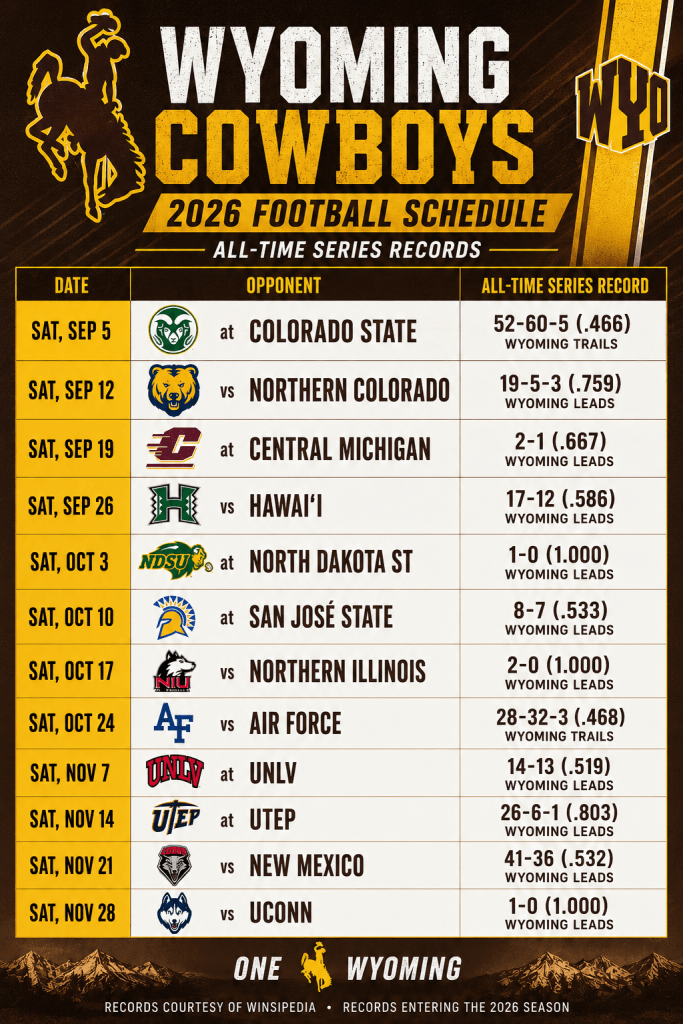
If Wyoming is going to return to bowl eligibility, the schedule provides a realistic pathway. The season opens with the Border War at Colorado State on Sept. 5, one of the Mountain West’s most heated rivalries. A victory would immediately energize the fan base and give the Cowboys momentum heading into the non-conference portion of the schedule.
Games against Northern Colorado, Central Michigan, Hawaii, and North Dakota State follow before conference play intensifies. The Mountain West slate includes home matchups against Northern Illinois, Air Force, New Mexico, and UConn, while Wyoming travels to San Jose State, UNLV, and UTEP.
The Cowboys avoid several of the conference’s projected contenders and should enter most Saturdays believing they have a legitimate chance to win. That’s a significant change from recent seasons.
Everything about Wyoming’s 2026 outlook comes back to one question. Can the Cowboys score enough points? The defense should remain competitive, even with significant roster turnover. The running game has potential. The schedule is manageable. But none of it matters if Wyoming continues to struggle offensively.
The pieces are in place for improvement. Wyoming upgraded its offensive staff, addressed key roster needs through the transfer portal, and benefits from a schedule that sets up favorably for a bounce-back campaign. The defense may experience some growing pains early, but Aaron Bohl’s track record suggests the unit will once again be among the better groups in the conference by season’s end.
The Cowboys don’t appear ready to challenge for a conference championship just yet, but they are positioned to take a meaningful step forward. For Jay Sawvel, that would represent more than just a winning season. It would be proof that Wyoming football is moving in the right direction again.
Projected Record: 7️⃣ – 5️⃣
Mountain West Finish: 4️⃣
Bowl Outlook: New Mexico Bowl
 The Ramblin Roundup
Leave a comment