
By Luke Fletcher | Atlanta, Georgia
For much of the past decade, college football realignment has been driven by one question: What do the Big Ten and SEC do next?
As television contracts, streaming platforms, and playoff expansion continue to reshape the sport, many industry observers believe the next major wave of realignment could arrive between 2030 and 2035. If that happens, the Atlantic Coast Conference could once again find itself at the center of the college athletics landscape.
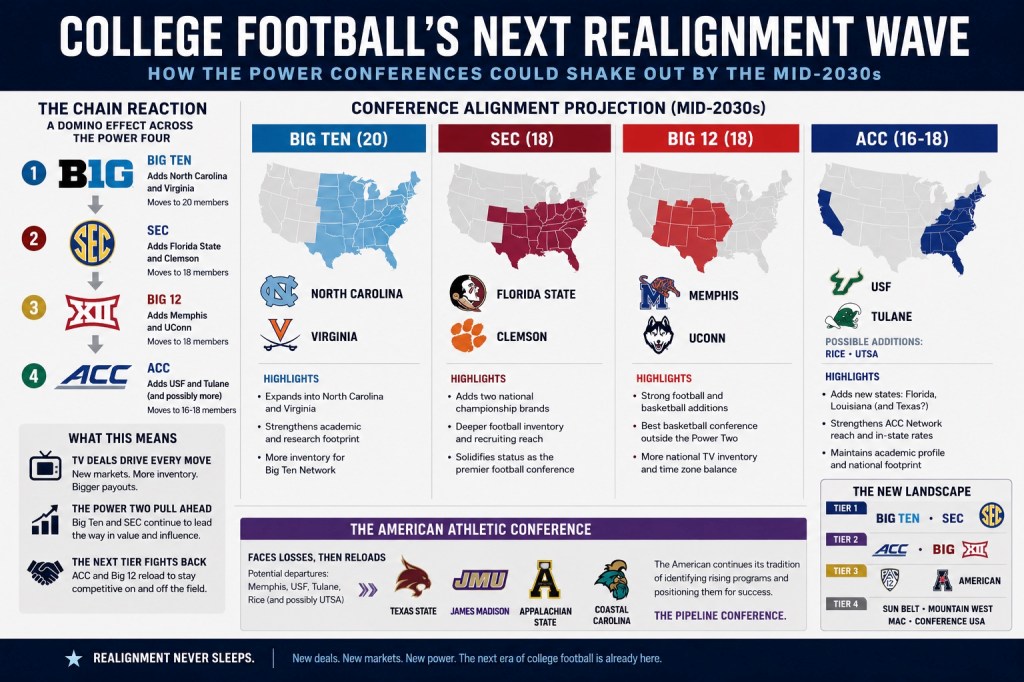
The scenario most frequently discussed by conference insiders is one in which the Big Ten and SEC each make targeted additions from the ACC, setting off a chain reaction across the Power Four.
The Big Ten Makes Its Move
With its landmark media rights deal expiring after the 2029-30 athletic year, the Big Ten will likely evaluate expansion opportunities before entering negotiations for its next television package.
Two schools consistently emerge as the most logical candidates:
- University of North Carolina
- University of Virginia
Both institutions fit the Big Ten’s traditional profile of elite academics, strong research portfolios, flagship university status, and access to growing population centers. Adding North Carolina and Virginia would expand the conference’s footprint into two of the fastest-growing states in the country while providing new inventory for the Big Ten Network.
A move to 20 members would position the conference favorably heading into its next media rights negotiations.
The SEC Targets Football Power
While the Big Ten focuses on institutional fit and market expansion, the SEC’s priorities remain straightforward: football brands and television ratings.
If given the opportunity, few schools would increase the SEC’s value more than:
- Florida State
- Clemson
Both programs have won national championships in the College Football Playoff era and possess passionate fan bases, elite recruiting territories, and national recognition. Adding the Seminoles and Tigers would push the SEC to 18 members and further solidify its position as college football’s premier conference.
The Big 12 Looks to Strengthen Its Hand
The Big 12 would likely enter media negotiations shortly after the Big Ten’s deal is completed, putting Commissioner Brett Yormark in a unique position.
Rather than chasing geography, the Big 12 would likely focus on content and brand value.
The two most logical additions would be:
- Memphis
- UConn
Memphis offers one of the strongest football and basketball combinations outside the Power Four, while UConn remains one of the most recognizable basketball brands in America. Together they would help strengthen the conference’s claim as the nation’s premier basketball league while adding valuable television inventory.
Can the ACC Survive?
The answer is likely yes.
Even after losing North Carolina, Virginia, Florida State, and Clemson, the ACC would still possess a respectable lineup featuring:
- Georgia Tech
- Miami
- NC State
- Virginia Tech
- Louisville
- Pitt
- Duke
- Syracuse
- Boston College
- Wake Forest
- Stanford
- Cal
- SMU
That group would retain access to major metropolitan markets including Atlanta, Miami, Dallas, Pittsburgh, Boston, and the San Francisco Bay Area.
The challenge would be replacing lost inventory and strengthening the ACC Network.
The ACC’s Most Logical Expansion Targets
To maximize value heading into its 2035 media negotiations, the ACC would likely focus on schools that bring new states, growing markets, and strong academic credentials and get to 16 members.
The top three candidates would be:
South Florida
The University of South Florida may be the most attractive expansion target available. As an AAU member and R1 research institution located in the Tampa Bay market, USF checks virtually every box the ACC values.
Tulane
Tulane would provide access to the New Orleans market while fitting seamlessly with the conference’s academic profile. The Green Wave’s recent football success only strengthens their candidacy.
Rice
Perhaps the most intriguing sleeper candidate, Rice would bring the Houston market, AAU membership, and one of the strongest academic reputations in college athletics.
If the ACC chose to expand to 18 members, schools such as UTSA, UNLV, and Colorado State could receive consideration due to the rapid population growth occurring Denver, Las Vegas, and San Antonio. However Duke and Stanford may prefer to stick to 16 plus ND.
The Biggest Loser? The American Athletic Conference
While the Power Four reshuffles, the American Athletic Conference could face another round of membership losses.
Potential departures of Memphis, South Florida, Tulane, and possibly Rice would force the AAC to reload once again. Fortunately, the conference has built a reputation for doing exactly that.
Likely candidates to replenish the league could include:
- Texas State
- James Madison
- Appalachian State
- Coastal Carolina
All four programs have demonstrated significant growth in recent years and could help the American maintain its status as the strongest Group of Five conference.
The Future Landscape
If this scenario unfolds, college football’s hierarchy by the mid-2030s could look something like this:
Tier One
- Big Ten
- SEC
Tier Two
- ACC
- Big 12
Tier Three
- Pac-12
- American Athletic Conference
The gap between the Power Two and everyone else may continue to widen, but the ACC and Big 12 would remain nationally relevant leagues capable of competing for College Football Playoff access and major television exposure. The next realignment battle may not be about survival. Instead, it could be about positioning.
And once again, television money will determine the winners and losers.


Leave a Reply