
By Luke Fletcher | Atlanta, Georgia
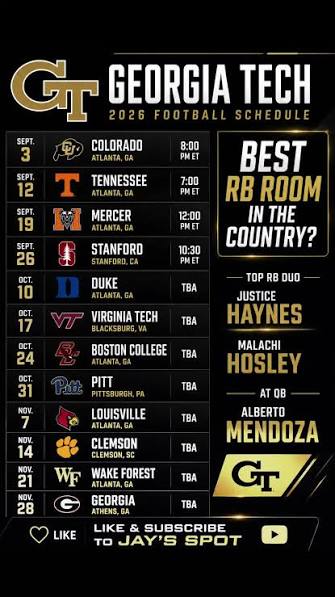
Georgia Tech secured its first victory of the 2026 season on Saturday with a 44-11 win over FCS opponent Mercer at Bobby Dodd Stadium. While the box score reflects a comfortable margin, the performance left lingering questions for head coach Brent Key’s squad just as the Yellow Jackets prepare to enter the grueling stretch of Atlantic Coast Conference play.
The Yellow Jackets (1-2) leaned heavily on individual playmaking to pull away from the Bears. Quarterback Alberto Mendoza delivered an efficient performance, completing 15 of 21 passes for 249 yards and three touchdowns. On the ground, running back Justice Haynes proved to be a workhorse, racking up 141 rushing yards and scoring three total touchdowns. Despite these flashy offensive numbers, the underlying metrics from Saturday’s game underscore a foundational issue: Georgia Tech must establish greater physicality on both the offensive and defensive lines if they hope to survive their remaining schedule.
The struggles at the line of scrimmage were apparent on both sides of the ball. Offensively, a reshaped line dealing with injuries to key starters like tackle Ethan Mackenny and center Jameson Riggs stalled early, opening the game with consecutive three-and-outs. Haynes was routinely forced to manufacture his own yardage rather than exploiting clean lanes. On the defensive side, the concerns were even more glaring. Mercer’s offense managed to rush for 207 yards, averaging nearly five yards per carry. This performance follows similar defensive breakdowns at the line in earlier losses to Colorado and Tennessee. Following the game, Coach Key candidly noted that stopping the run remains a “major work in progress.”
Failing to establish a physical identity up front could prove costly given the slim margins for error across the rest of the season. According to ESPN’s Football Power Index (FPI), Georgia Tech faces an uphill battle to reach bowl eligibility, with several looming conference matchups tracking as virtual toss-ups or heavy disadvantages.
To see exactly how the analytical models view the road ahead, here are the precise game-by-game win percentage probabilities for the rest of the 2026 season:
Georgia Tech 2026 Remaining Game-by-Game Win Probability
| Date | Opponent | Location | win Probability |
|---|---|---|---|
| Sep 26, 2026 | at Stanford | Stanford, CA | 57.0% |
| Oct 10, 2026 | vs Duke | Atlanta, GA | 51.0% |
| Oct 17, 2026 | at Virginia Tech | Blacksburg, VA | 22.0% |
| Oct 24, 2026 | vs Boston College | Atlanta, GA | 55.0% |
| Oct 31, 2026 | at Pittsburgh | Pittsburgh, PA | 18.0% |
| Nov 07, 2026 | vs Louisville | Atlanta, GA | 40.0% |
| Nov 14, 2026 | at Clemson | Clemson, SC | 15.0% |
| Nov 21, 2026 | vs Wake Forest | Atlanta, GA | 45.0% |
| Nov 28, 2026 | at Georgia | Athens, GA | 3.0% |
The regular-season gauntlet starts this weekend with the ACC opener on the road against Stanford, a game that models view as a critical swing matchup. Tech returns home to face the Duke Blue Devils before heading back on the road against a formidable Virginia Tech team. A home game against the Boston College Eagles offers another narrow window for a victory, but the schedule grows increasingly difficult. The final stretch includes challenging road trips to face the Pittsburgh and Clemson, alongside home dates versus Louisville and Wake Forest. The season concludes with Clean, Old-Fashioned Hate against the rival Georgia Bulldogs in Athens, where the model gives Tech just a 3.0% chance of an upset.
For Georgia Tech to buck these projections and secure the six wins needed for a bowl eligibility, the team must urgently find answers in the trenches. Coach Key has long preached toughness and line-of-scrimmage dominance as the bedrock principles of his coaching philosophy. Moving deeper into autumn, those words must translate into on-field production. If the Yellow Jackets cannot dictate the physical terms of engagement against ACC opponents, the questions surrounding the program’s direction will only intensify. Go Jackets!
 The Ramblin Roundup
Leave a comment