
By Luke Fletcher | Ft Collins, Colorado
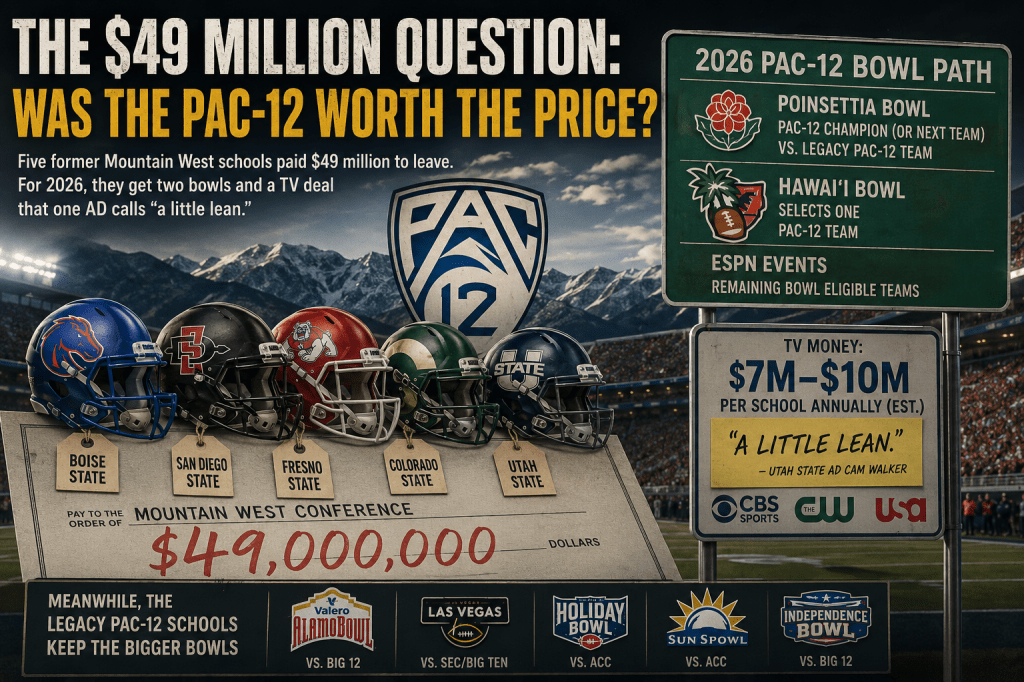
Boise State, San Diego State, Fresno State, Colorado State and Utah State paid dearly to escape the Mountain West. As the rebuilt Pac-12 finally takes the field, its television and bowl packages make the price worth examining.
The new Pac-12 finally has what it spent two years fighting to build.
It has Boise State. It has San Diego State. It has Fresno State. It has Colorado State and Utah State. Oregon State and Washington State have a rebuilt conference around them, Texas State completes the eight-team football lineup, and every Pac-12-controlled football game in 2026 will be available on national linear television through CBS Sports, The CW and USA Sports.
On paper, it looks like a victory.
Then comes the bill.
The five schools leaving the Mountain West for the Pac-12: Boise State, Colorado State, Fresno State, San Diego State and Utah State, agreed to pay their former conference $49 million as part of the settlement of their exit-fee dispute.
That’s an average of nearly $10 million per departing school.
And now that the rebuilt Pac-12’s television and postseason picture has come into focus, it’s fair to ask a question that would have seemed almost unthinkable when the realignment battle began:
What exactly did those five schools buy for $49 million?
A Pac-12 Without the Pac-12 Bowls
Start with perhaps the strangest element of the entire 2026 college football postseason.
The new Pac-12 doesn’t really get the old Pac-12’s bowl lineup.
At least not yet.
The 10 schools that departed the original conference remain connected to the legacy Pac-12 bowl structure for the final year of the existing postseason cycle.
That means the traditional Pac-12 inventory includes games such as the Alamo, Las Vegas, Holiday, Sun and Independence bowls, potentially providing matchups against teams from the Big 12, Big Ten and ACC.
Except those opportunities primarily belong to the former Pac-12 schools.
The actual 2026 Pac-12 members have a different postseason path.
Its centerpiece is the revived Poinsettia Bowl in San Diego, which provides the new conference with a high-profile destination and the possibility of matching a new Pac-12 team against one of the departed legacy Pac-12 programs.
Then comes the Hawaii Bowl, followed by the complicated world of ESPN-controlled bowl inventory and potential bowl swaps.
That’s not necessarily a bad bowl lineup.
But it certainly isn’t what most fans picture when they hear “Pac-12.”
Consider the contrast.
The old Pac-12 group could potentially send teams to the Alamo, Holiday, Las Vegas, Sun and Independence bowls.
The new Pac-12’s clearly defined marquee destinations begin with Poinsettia and Hawaii.
For five schools that just agreed to send $49 million back to the Mountain West, that’s worth noticing.
The Poinsettia Bowl Is Important — Very Important
That doesn’t mean the Pac-12 struck out.
Far from it.
Reviving the Poinsettia Bowl was important because the conference needed something beyond the College Football Playoff to reward its best team.
The San Diego location makes sense. San Diego State is now a Pac-12 member, Snapdragon Stadium provides a modern venue, and a matchup involving a new Pac-12 contender against a former Pac-12 school has real television potential.
Imagine:
Boise State vs. Oregon.
San Diego State vs. UCLA.
Utah State vs. Utah.
Washington State vs. Washington.
Those games sell themselves.
But there is a substantial difference between having one potentially excellent postseason showcase and possessing the deep bowl inventory historically associated with the Pac-12 name.
For 2026, that difference is glaring.
Then There’s the Television Money
This was supposed to be where the Pac-12 separated itself.
And in one important category, it absolutely has.
Exposure.
The Pac-12 says 100% of its league-controlled 2026 football schedule will appear on national linear television through CBS Sports, The CW and USA Sports. The conference championship will air on CBS and Paramount+.
For a conference trying to establish itself as the clear No. 5 league in college football, that’s significant.
There is no hunting for games on an obscure streaming platform.
Boise State, Oregon State, Washington State, San Diego State and the rest of the league will be widely available nationally.
The problem is that great distribution doesn’t necessarily mean great money.
Utah State athletic director Cam Walker described the anticipated media-rights revenue as “a little lean,” with reported estimates generally hovering around the $7 million-to-$10 million-per-school range annually.
That’s considerably better than what these schools were accustomed to receiving in the Mountain West.
But it’s also nowhere near Power Four territory.
And that’s significant because this realignment was sold, at least conceptually, as more than switching from one Group-of-Six conference to another.
The Pac-12 was supposed to create separation.
Better Than the Mountain West? Yes.
Let’s establish something important.
If the question is simply whether the rebuilt Pac-12 is stronger than the Mountain West, the answer appears straightforward.
Yes.
Boise State has been one of the premier non-power football programs of the modern era.
San Diego State has significant market and institutional value.
Fresno State brings a strong football tradition.
Colorado State has invested heavily in facilities.
Utah State has had periods of considerable football success.
Oregon State and Washington State bring decades of Power Five infrastructure and history.
Texas State gives the league a growing program in football-crazed Texas.
Put those eight together and the Pac-12 immediately has a strong argument as the best football conference outside the Power Four.
The league also built a television package designed around national visibility. Its 2026 home schedule will be spread across CBS, CBS Sports Network, The CW and USA Network, while Pac-12 Enterprises will remain heavily involved in producing the broadcasts.
The Pac-12 won the football-brand battle.
But that isn’t the same as winning the financial argument.
How Long Does It Take to Recover $49 Million?
Here’s where the discussion gets interesting.
Take a hypothetical former Mountain West school earning approximately $4 million annually under the old television arrangement.
Now assume its Pac-12 distribution eventually lands at $8 million annually.
That’s roughly a $4 million annual increase.
Compare that with an average share of the five-school settlement of approximately $9.8 million.
At that rate, it would take roughly 2½ years of additional media revenue merely to recover the average exit-settlement expense.
If the Pac-12 payout settles closer to $7 million, the difference could be closer to $3 million annually.
Now the payback period moves beyond three years.
If distributions eventually approach $10 million, the math becomes considerably more favorable.
Of course, that’s a simplified calculation. Conference distributions include much more than television rights, and the schools aren’t necessarily responsible for identical shares of every realignment expense.
But it illustrates the larger point.
This wasn’t free money.
The five schools made a substantial upfront investment to get into the Pac-12.
And Production Isn’t Free
There’s another piece of the media deal that tends to get overlooked.
The Pac-12 didn’t simply hand its entire production operation to its television partners.
Pac-12 Enterprises remains heavily involved in producing and presenting the conference’s football inventory.
That infrastructure has value. In fact, retaining Pac-12 Enterprises could ultimately become one of the league’s smartest decisions.
But cameras, production crews, equipment, facilities and personnel cost money.
So when comparing reported gross media-rights figures with what athletic departments ultimately receive, production obligations matter.
Again, that doesn’t make the television deal bad.
It simply makes calling it a financial home run premature.
The Real Prize Isn’t the Poinsettia Bowl
Here’s where the Pac-12’s gamble begins to make more sense.
Boise State didn’t pay millions to reach the Poinsettia Bowl.
San Diego State didn’t leave the Mountain West because it desperately wanted access to the Hawaii Bowl.
Fresno State didn’t change conferences because it wanted different patches on its uniforms.
The five schools paid for something much harder to put on a spreadsheet:
positioning.
College football is separating into tiers.
The Big Ten and SEC occupy the penthouse.
The Big 12 and ACC remain firmly inside the Power Four structure.
Then comes everyone else.
The Pac-12’s gamble is that it can create enough separation from the Mountain West, American, Sun Belt, Conference USA and MAC that the sport eventually views it differently.
Not quite Power Four.
But not quite Group of Six either.
Think of it as college football’s middle class of one.
And that could become extraordinarily valuable if the CFP expands again, television contracts change or another round of conference realignment arrives.
Boise State Might Be the Key
No school better illustrates the gamble than Boise State.
The Broncos don’t need a conference logo to establish football credibility.
What Boise State needs is a structure capable of converting its football success into greater revenue, CFP access and national relevance.
That’s what the Pac-12 is attempting to provide.
If Boise State goes 12-1, wins the Pac-12 championship and reaches the CFP, nobody in Boise is going to care that the league’s No. 2 bowl arrangement wasn’t as lucrative as the Alamo Bowl.
Likewise, if the Pac-12 consistently puts its champion in the playoff, gets multiple teams ranked and produces nationally relevant games on CBS, The CW and USA, the television value should increase when the next negotiation arrives.
That’s the bull case for the Pac-12.
The conference isn’t necessarily buying today’s value.
It’s attempting to create tomorrow’s value.
But $49 Million Raises Expectations
That’s why the number matters.
$49 million.
It changes the standard by which this experiment should be judged.
The Pac-12 shouldn’t merely be slightly better than the Mountain West.
It needs to become substantially more valuable.
The television contract needs to grow.
The Poinsettia Bowl needs to become a meaningful postseason property.
The conference champion needs to remain in the CFP conversation.
National ratings need to demonstrate that Boise State, Washington State, Oregon State, San Diego State and the rest of the conference can draw viewers.
And eventually the Pac-12 needs a deeper bowl lineup worthy of its football ambitions.
Because the immediate return is surprisingly modest.
Five former Mountain West schools agreed to pay $49 million to leave their conference.
Their new league has tremendous television exposure, but its projected media revenue has been described by one of its own athletic directors as “a little lean.”
Its best 2026 bowl asset is the revived Poinsettia Bowl.
Its next clearly defined destination is Hawaii.
Meanwhile, the departed members of the old Pac-12 remain attached to the Alamo, Holiday, Las Vegas, Sun and Independence bowl structure for another season.
None of that means the move was a mistake.
It means the move was a bet.
A very expensive one.
The Verdict
The rebuilt Pac-12 doesn’t need to become the fifth Power conference overnight.
But after everything its new members spent to get there, simply becoming Mountain West Plus won’t be enough.
The conference needs to create a meaningful gap between itself and the rest of the Group of Six.
Better television.
Better recruiting.
Better CFP access.
Better postseason opportunities.
And, eventually, significantly better revenue.
If that happens, nobody will remember the $49 million exit bill.
If it doesn’t, the first season of the rebuilt Pac-12 may eventually be remembered for an uncomfortable financial question:
Did Boise State, San Diego State, Fresno State, Colorado State and Utah State pay nearly $50 million to move up, or did they pay nearly $50 million to move sideways?


Leave a comment