
By Luke Fletcher | Atlanta, Georgia
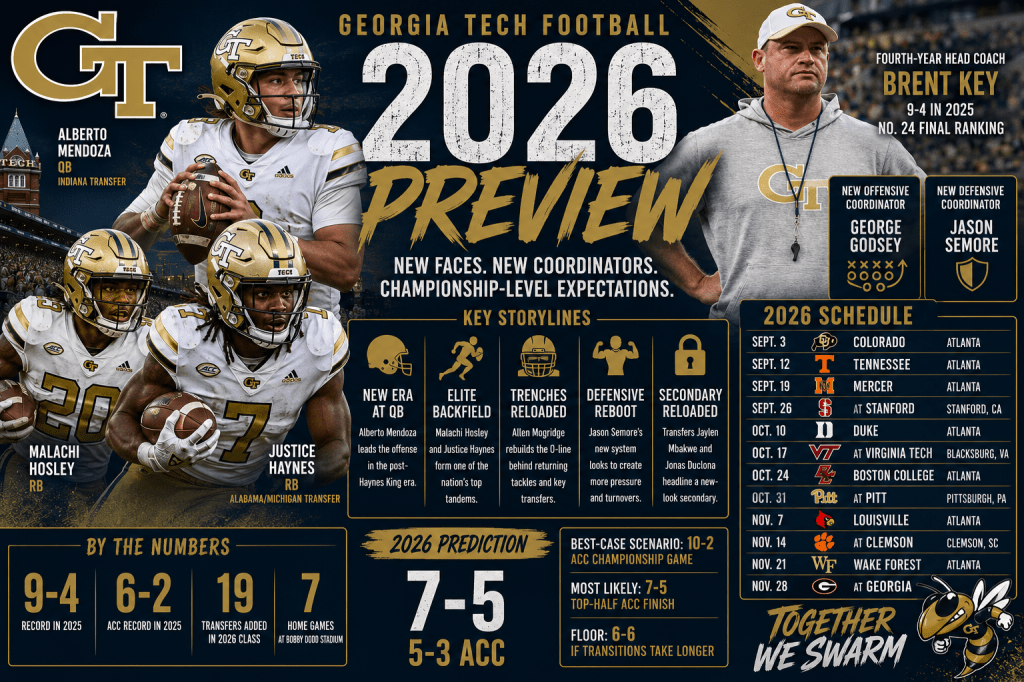
Head coach Brent Key didn’t like the way Georgia Tech finished last season—and quite frankly, neither did the fan base. The 2025 Yellow Jackets gave supporters a glimpse of what elite college football in Atlanta could look like. Georgia Tech raced out to a historic 8-0 start, climbing as high as No. 7 in the Associated Press Top 25 after signature victories over Clemson and eventual ACC champion Duke. Quarterback Haynes King emerged as one of the nation’s top players, finishing 10th in Heisman Trophy voting, while an appearance in the ACC Championship Game appeared all but inevitable.
Then, everything unraveled.
Beginning in November, Georgia Tech stumbled to a 1-4 finish over its final five games. The defense struggled to get stops during a 48-36 loss to NC State, the offense never found its rhythm against rival Georgia, and the season ended on a disappointing note with a 25-21 loss to BYU in the Pop-Tarts Bowl. Despite finishing 9-4 and earning a No. 24 final national ranking, the late-season collapse exposed several weaknesses that had to be addressed before the program could legitimately contend for an ACC championship.
Brent Key’s Response: A Program Reset
Rather than making small adjustments, Brent Key chose to make sweeping changes. Georgia Tech enters the 2026 season with two new coordinators, a new OL coach, a new starting quarterback, and a roster significantly reshaped through the transfer portal. The goal wasn’t simply to replace departing talent—it was to build a roster capable of sustaining success throughout an entire season.
Former Georgia Tech quarterback and longtime NFL assistant George Godsey returns to Atlanta to coordinate the offense. His task will be developing Indiana transfer Alberto Mendoza while maximizing one of the nation’s deepest running back rooms.
On defense, Jason Semore arrives after coordinating Southern Miss’s defense. His mission is straightforward: create more pressure, force more turnovers, and prevent the defensive breakdowns that plagued Georgia Tech during last season’s stretch run.
The Ultimate Question for 2026
As preseason camp begins, one question surrounds the Yellow Jackets:
Can Georgia Tech immediately rebound and challenge for an ACC Championship, or will 2026 serve as a transitional season while the new coaching staff and roster develop together?
The answer will likely determine whether Brent Key’s program takes the next step toward becoming a consistent College Football Playoff contender or spends another year building toward that goal.
The Post-Haynes King Era Begins
For the first time since 2023, someone other than Haynes King is expected to open the season as Georgia Tech’s starting quarterback.
King completed his college career after leading the Jackets’ resurgence and signed with the Carolina Panthers as an undrafted free agent. His toughness, mobility, leadership and experience will not be easily replaced.
Indiana transfer Alberto Mendoza enters preseason camp as the favorite to take control of the offense. The 6-foot-2 redshirt sophomore was one of the headline additions in Tech’s 19-player transfer class and offers intriguing long-term potential.
Mendoza made a strong first impression during the White and Gold spring game, completing 12 of 16 passes for 148 yards and a touchdown. Although an intrasquad scrimmage cannot replicate an ACC game, his performance offered encouraging evidence that the offense will not have to become entirely one-dimensional.
The most important question is not whether Mendoza can immediately reproduce King’s individual production. It is whether he can protect the football, convert third downs and consistently distribute the ball to Georgia Tech’s playmakers.
One of the Nation’s Most Intriguing Backfields
Georgia Tech’s greatest offensive strength should be its running back room. Malachi Hosley returns after establishing himself as an explosive and dependable option during the 2025 season. He is joined by former Alabama and Michigan running back Justice Haynes, a highly regarded former five-star prospect and one of the most significant transfer additions in the ACC.
Haynes and Hosley provide Georgia Tech with two backs capable of handling a featured role. Their contrasting styles should allow Godsey to rotate them without dramatically changing the offense.
Haynes ran nine times for 48 yards in the spring game, while Hosley averaged 6.5 yards on four attempts and scored on an 18-yard run. Sophomore J.P. Powell also produced 68 yards on three carries, demonstrating the depth available behind the two leading backs.
The combination of Haynes and Hosley could become one of college football’s premier rushing duos. Georgia Tech ranked 21st nationally in rushing offense in 2025 at 197.5 yards per game, and the Jackets should again make the ground game the foundation of their identity.
Rebuilding the Offensive Line
The Yellow Jackets must replace first-round NFL Draft pick Keylan Rutledge, but the offensive line is not starting from scratch. New offensive line coach Allen Mogridge inherits a unit anchored by returning tackles Ethan Mackenny and Malachi Carney. Mogridge previously worked at Georgia Tech as a senior offensive advisor before returning in December 2025 to lead the position group.
Mackenny started all 13 games at left tackle in 2025, earned honorable-mention All-ACC recognition and surrendered only one sack, according to Pro Football Focus data cited by Georgia Tech. Carney provides another experienced building block and received preseason All-ACC recognition from multiple publications.
Alabama transfer Joseph Ionata is expected to compete for a major role along the interior. Appalachian State and Oklahoma State transfer Markell Samuel, Auburn transfer Favour Edwin and former five-star recruit Josh Petty give Mogridge several options as he constructs the starting five.
The offensive line does not need to be flawless immediately. It must, however, remain dependable enough to protect an inexperienced quarterback and prevent defenses from loading the box against the running game.
Finding Answers at Wide Receiver
Wide receiver may be the offense’s biggest uncertainty. Georgia Tech has several intriguing options but lacks an established No. 1 target. Transfers Jaiven Plummer and Isaiah Fuhrmann add size, while Debron Gatling, Jordan Allen and Dalen Penson provide speed and developmental potential.
Gatling caught an 18-yard touchdown from Mendoza during the spring game, while Allen recorded 42 receiving yards. Tight end Kevin Roche Jr. was another spring standout, leading all receivers with six catches for 70 yards.
Godsey does not necessarily need one receiver to dominate the passing game. A balanced rotation could work, particularly with the amount of attention opposing defenses must devote to the backfield. But at least one dependable target must emerge for obvious passing situations.
Jason Semore Takes Over the Defense
Georgia Tech’s defense enters a new era under Jason Semore, who arrives from Southern Miss as defensive coordinator and linebackers coach. Semore inherits a unit that must become more disruptive. The Jackets need to create more negative plays, generate consistent pressure without excessive blitzing and improve their ability to get off the field on third down.
The transfer portal was used heavily to address the defensive front. The Yellow Jackets added defensive tackles Vincent Carroll-Jackson, Tim Griffin and Tawfiq Thomas, along with edge defenders Noah Carter, Taje McCoy and Jordan Walker.
The new additions bring size and Power Four experience, but Semore must quickly establish a dependable rotation. Georgia Tech’s ceiling may ultimately be determined by whether the front four can pressure quarterbacks without exposing the secondary.
Veteran Strength at Linebacker
Linebacker should be one of the defense’s most stable units. Senior Kyle Efford returns as an emotional and physical leader. He earned preseason All-ACC recognition after helping anchor the 2025 defense. E.J. Lightsey also returns after finishing second on the team with 77 tackles during his first full collegiate season.
Their experience should ease the transition into Semore’s system. Efford’s ability to diagnose plays and communicate assignments will be especially important while the defensive line and secondary incorporate several transfers.
Secondary Reloaded Through the Portal
The secondary lost experienced contributors but received an immediate infusion of talent. Former Alabama defensive back Jaylen Mbakwe is the most recognizable addition. His athleticism gives Georgia Tech someone capable of matching up with the ACC’s faster receivers. USF transfer Jonas Duclona should also compete for a starting cornerback position.
Penn State transfer Jon Mitchell, UAB transfer Kelvin Hill and returning safety Savion Riley provide additional experience. Georgia Tech has enough options to build a productive secondary, but communication and consistency will be critical under a new defensive staff.
Special Teams Could Be a Major Advantage
Kicker Aidan Birr gives Georgia Tech a proven difference-maker. Birr was a finalist for the 2025 Lou Groza Award and connected on a 48-yard field goal during the spring game. His range could decide multiple close contests, especially with Georgia Tech facing several opponents of comparable talent.
A reliable kicker provides Key with the flexibility to play conservatively in tight games while the new quarterback and coordinators settle into their roles.
Breaking Down the 2026 Schedule
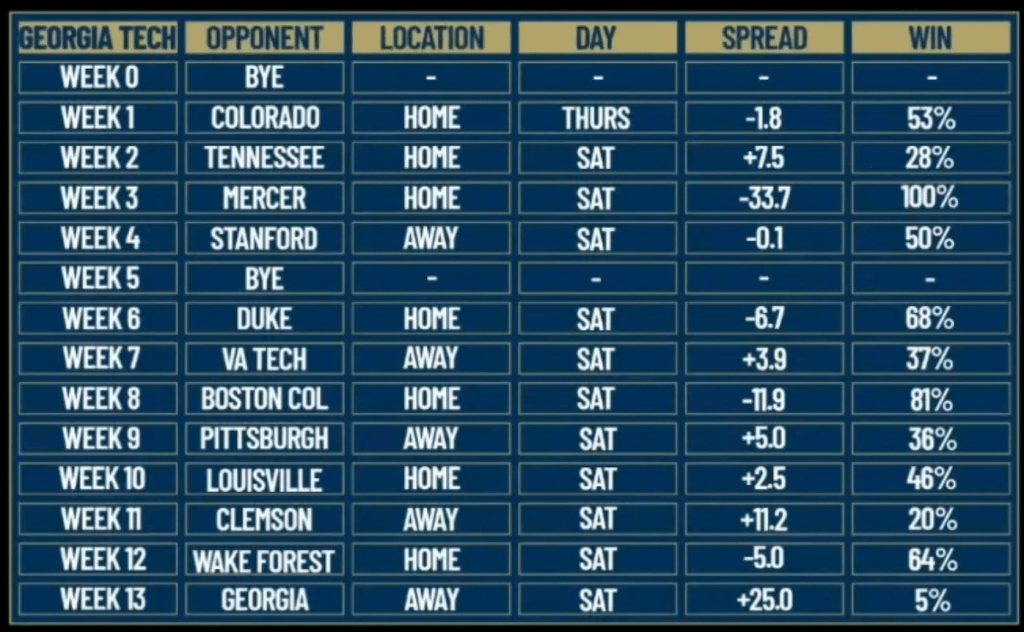
Georgia Tech faces one of the ACC’s most challenging schedules. The Jackets play seven games at Bobby Dodd Stadium, but their non-conference slate includes Colorado, Tennessee and Georgia. Their ACC road schedule features trips to Stanford, Virginia Tech, Pittsburgh and Clemson.
September Will Set the Tone
The Jackets open on Thursday night against Colorado in an ESPN national broadcast before hosting Tennessee nine days later. Those games will provide immediate answers about Mendoza, the rebuilt offensive line and Semore’s defense. Georgia Tech then hosts Mercer before making a cross-country trip to Stanford.
A 3-1 September would position Tech for another strong season. A 2-2 start would not end its ACC hopes, but it would create little room for error during the second half of the schedule.
The Critical Middle Stretch
Following an open date, Georgia Tech plays Duke, Virginia Tech, Boston College and Pitt on consecutive weekends. This four-game stretch may determine the season. All four matchups appear winnable, but road trips to Blacksburg and Pittsburgh are rarely comfortable. Tech needs to win at least three of these games to remain in serious ACC contention entering November.
A Brutal November Finish
The final month includes Louisville at home, Clemson on the road, Wake Forest at home and Georgia in Athens. That stretch contains three opponents capable of competing for conference or national championships. It also arrives after Georgia Tech will have played seven consecutive weeks following its early October open date.
Depth, health and line play will become increasingly important. Even a strong Georgia Tech team could struggle to navigate November without suffering multiple losses.
Three Keys to the Season
1. Mendoza must manage the transition
Georgia Tech does not need Mendoza to become Haynes King immediately. It needs him to avoid costly mistakes, operate the offense efficiently and punish defenses that overcommit to stopping RB Haynes and Hosley.
2. The defensive front must create pressure
The Jackets added several transfers specifically to improve the line of scrimmage. If the front four cannot disrupt opposing quarterbacks, the secondary will face too much pressure against Tennessee, Louisville, Clemson and Georgia.
3. Tech must win the toss-up games
The schedule contains several matchups that could be decided in the fourth quarter. Colorado, Stanford, Virginia Tech, Pitt, and Louisville may separate a seven-win season from another nine-win campaign.
2026 Season Prediction
Georgia Tech has enough talent to remain one of the ACC’s better teams, but the combination of a new quarterback, new coordinators and an unforgiving schedule creates considerable uncertainty.
The running backs, offensive tackles, linebackers and kicker give the Jackets a strong foundation. The biggest concerns are quarterback experience, receiver development, interior offensive-line chemistry and the defense’s ability to consistently pressure the passer.
A return to nine wins is possible, particularly if Mendoza develops quickly and Georgia Tech wins its close ACC games. However, some transition-related inconsistency should be expected.
Projected record: 7-5 overall, 5-3 ACC
Best-case scenario: 10-2 and an appearance in the ACC Championship Game.
Most likely scenario: Seven wins and a quality bowl invitation.
Floor: 6-6 if the QB transition and defensive rebuild take longer than expected, and a low bowl bid.
Georgia Tech enters 2026 looking different, but one thing has changed forever—the expectations. Brent Key has transformed the Yellow Jackets from a rebuilding program into an ACC contender capable of lining up and competing with anyone on the schedule. Now comes the biggest test yet: proving last season wasn’t the peak, but the foundation of something built to last. Go Jackets!


Leave a Reply