
By Luke Fletcher | Atlanta, Georgia
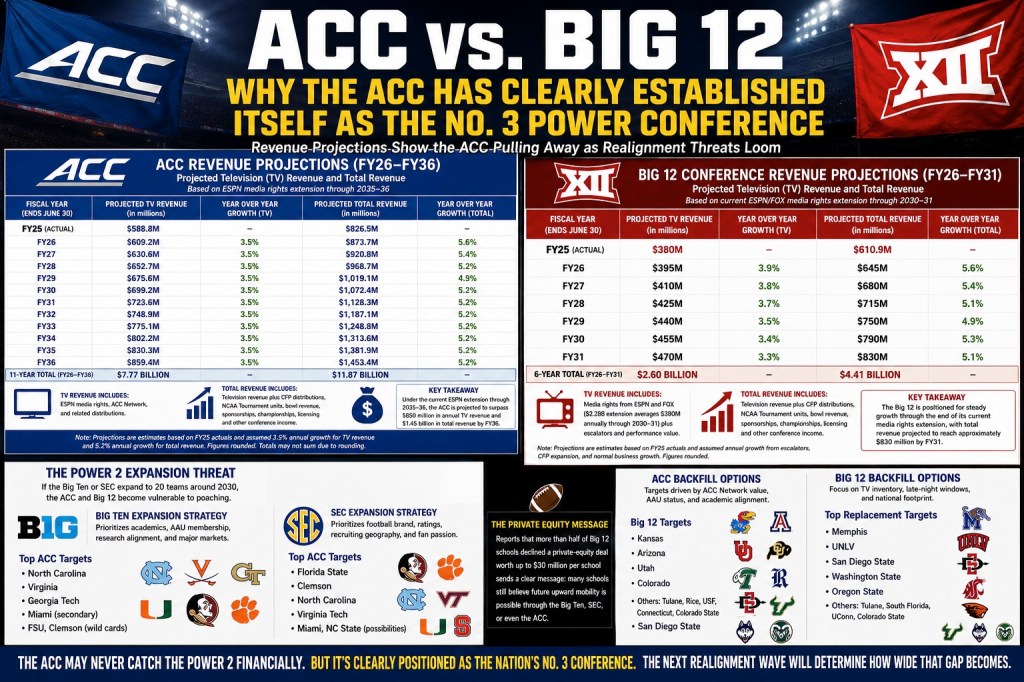
The financial gap between the Power 2 and everyone else still exists. That part hasn’t changed. But what has changed over the last few years is the growing separation between the ACC and the Big 12 and why the ACC increasingly looks like the conference best positioned to own the No. 3 spot in college athletics for the next decade.
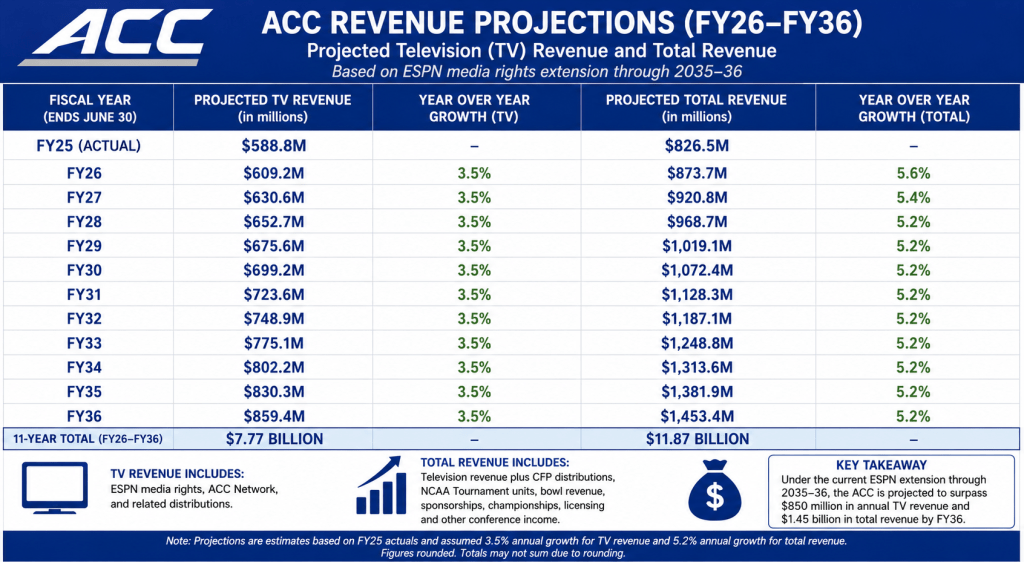
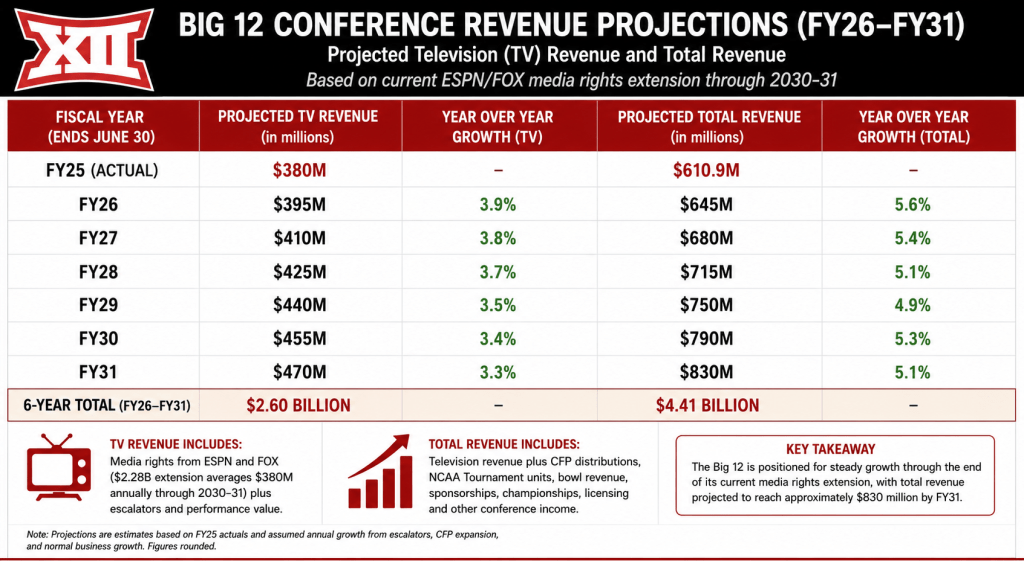
The latest numbers tell the story. The Atlantic Coast Conference generated roughly $826.5 million in total revenue during FY25, including nearly $589 million in television revenue alone. Meanwhile, the Big 12 Conference reported approximately $610.9 million in total revenue with media rights tied to its six-year, $2.28 billion ESPN/FOX agreement averaging about $380 million annually.
Those are both healthy numbers, however they are not the same tier of operation anymore. When future projections are layered in, including ESPN escalators, College Football Playoff expansion money, and long-term network value, the ACC starts looking much more like a conference that has separated itself from the rest of the pack outside the Big Ten Conference and Southeastern Conference.
By the mid-2030s, projections could push the ACC near:
- $800 million annually in TV revenue
- and more than $1.3 billion in total conference revenue.
That matters because the ACC’s long-term structure is fundamentally different than the Big 12’s. The ACC has something the Big 12 doesn’t: ACC Network.
That network changes everything. While the Big 12 operates primarily as a rights-inventory conference, the ACC has a vertically integrated media ecosystem tied directly into ESPN’s long-term strategy. Every new state footprint matters because of in-state ACCN carriage rates. Every subscriber matters. Every streaming bundle matters.
That doesn’t mean the ACC will ever catch the SEC or Big Ten financially. It probably won’t, but the gap between the ACC and Big 12 could widen considerably over the next decade if current projections hold.
And that’s where the next realignment wave becomes fascinating.
Because even while the ACC looks increasingly stable financially, both the ACC and Big 12 still face the same looming threat: What happens if the SEC and Big Ten decide 16 teams isn’t enough?
If the Power 2 eventually expand to 20 schools sometime around 2030, the ACC becomes the primary hunting ground for both conferences.
The Big Ten’s targets are fairly obvious. If the league prioritizes academics, AAU membership, and research alignment, which historically it always has, then schools like:
- North Carolina Tar Heels
- Virginia Cavaliers
- Georgia Tech Yellow Jackets
become extremely attractive.
North Carolina, in particular, may be the crown jewel of the entire ACC. The Tar Heels bring basketball prestige, a growing football brand, elite academics, and a booming state footprint that both the Big Ten and SEC covet.
Virginia checks nearly every traditional Big Ten box imaginable:
AAU membership, research power, affluent alumni support, and proximity to the Washington D.C. corridor.
Georgia Tech quietly remains one of the most intriguing wild cards in the country because of Atlanta, academics, and research value, even if the football product hasn’t consistently matched the institutional profile in the last decade.
The SEC’s strategy looks very different. The SEC cares less about research alliances and far more about football inventory, television ratings, recruiting geography, and fan passion.
That’s why:
- Florida State Seminoles
- and Clemson Tigers
feel almost tailor-made for SEC expansion if the opportunity ever presents itself. Both programs deliver elite football brands, national ratings power, and recruiting dominance in the Southeast. They fit the SEC culturally as much as financially.
The SEC would almost certainly have interest in North Carolina as well if expansion ever accelerated. So where does that leave the ACC?
Ironically, possibly in a stronger position than many expected a few years ago, because if the ACC loses schools, the conference still possesses something incredibly valuable: a long-term ESPN partnership and a mature conference network.
That means the ACC could immediately pivot toward selective expansion with a very different philosophy than the Big 12. The ACC’s future targets would likely center around:
- AAU membership
- R1 research status
- ACC Network expansion
- institutional alignment
- and in-state ACCN carriage value.
That makes schools like:
- Kansas Jayhawks
- Arizona Wildcats
- Utah Utes
- Colorado Buffaloes
extremely logical ACC targets if another realignment cycle begins. Kansas brings elite basketball inventory and AAU status. Arizona and Utah offer strong academics, growing western markets, and football upside. Colorado delivers the Denver market and fits the ACC institutionally far better than many fans realize.
And if the ACC ever needed deeper backfill options, schools like:
- Tulane Green Wave
- Rice Owls
- South Florida Bulls
- Connecticut Huskies
- Colorado State Rams
- San Diego State Aztecs
all begin making more sense through the lens of academics, research profile, and network economics. Meanwhile, the Big 12 would likely respond very differently.
Commissioner Brett Yormark has built the conference around flexibility, inventory, and national reach. If the Big 12 loses schools, expect the league to aggressively pursue programs that maximize television windows and maintain coast-to-coast relevance.
That’s why schools like:
- Memphis Tigers
- UNLV Rebels
- San Diego State Aztecs
- Washington State Cougars
- Oregon State Beavers
- Tulane Green Wave
- South Florida Bulls
- Boise State Broncos
continue surfacing in expansion conversations.
UNLV, in particular, may become one of the most valuable long-term chips on the board because of Las Vegas’ exploding sports and entertainment value.
And then there’s the private-equity wrinkle. Reports that more than half of Big 12 schools declined participation in a proposed private-equity deal worth up to $30 million per school may have quietly revealed something important: many schools still believe future upward mobility remains possible. That decision felt less like a rejection of money and more like a message:
“We don’t want to lock ourselves into anything before the next realignment wave.”
That matters. Because despite years of “the ACC is dead” narratives, the conference now appears increasingly stable, and increasingly valuable, in a rapidly consolidating sports landscape.
The SEC and Big Ten may own the top tier, but the ACC increasingly looks like the conference best positioned to survive everything happening beneath them.


Leave a Reply