
By Luke Fletcher | Atlanta, Georgia
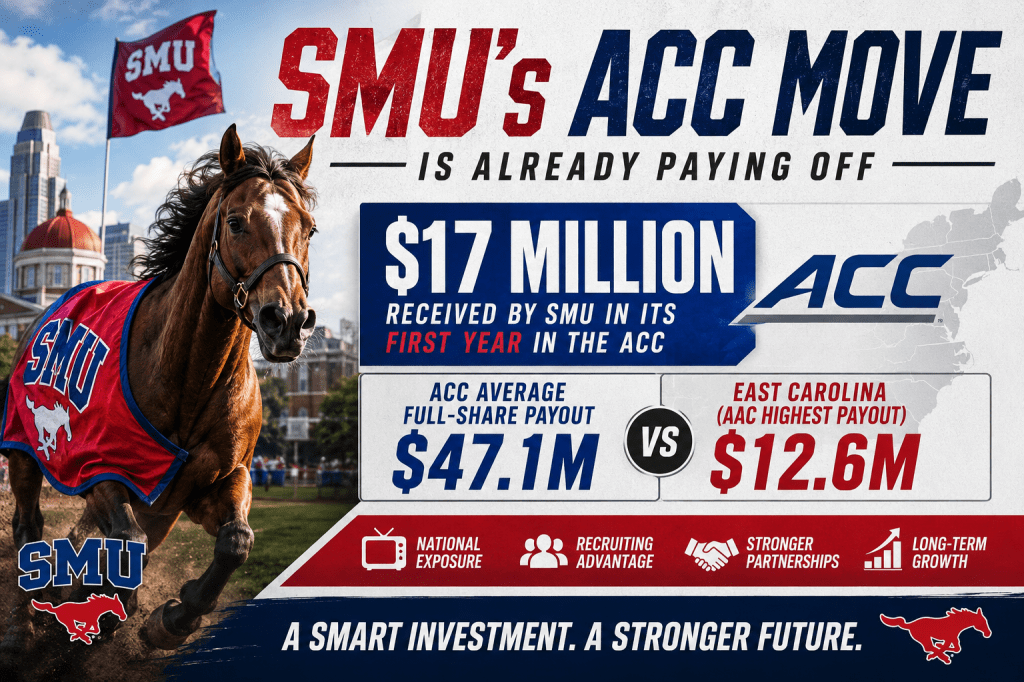
When SMU announced it was joining the ACC, the headlines focused on one thing: sacrifice. The Mustangs agreed to forgo their Tier 1 media-rights revenue for the first nine years of conference membership in order to secure a spot in one of college athletics’ Power conferences. Critics questioned whether the move made financial sense in the short term.
Now, one year later, the early numbers tell a very different story. According to recently released ACC tax filings reported by multiple outlets, SMU still brought in approximately $17 million during its first season in the ACC. That number may not sound massive compared to the ACC’s full-share average payout of $47.1 million, but context changes everything.
The highest revenue payout in the American Athletic Conference , SMU’s former home, reportedly went to East Carolina at approximately $12.6 million. In other words, even while taking a reduced share in the ACC, SMU still earned millions more than the AAC’s top-paying member.
That’s a staggering reality for a program that willingly accepted reduced distributions just to gain entry into the league. This was never just about Year One revenue.
SMU’s leadership understood the modern college athletics landscape. Conference affiliation now drives everything:
- Television exposure
- Recruiting reach
- NIL opportunities
- Corporate partnerships
- Brand visibility
- Long-term athletic department valuation
The ACC gives SMU a national platform the AAC simply could not match.
Instead of playing primarily regional matchups tucked away on secondary time slots, SMU is now attached to a conference that regularly features national broadcasts, marquee brands, and College Football Playoff relevance.
That exposure matters. SMU essentially made a long-term investment in itself.
The university bet that increased visibility, recruiting momentum, donor engagement, and future conference stability would outweigh the short-term sacrifice of not receiving a full media share immediately. So far, that gamble appears to be working.
Even at a partial share, SMU out-earned every AAC school in media distributions. That alone illustrates the widening financial gap between Power conferences and the Group of Five and this is only the beginning. As ACC media revenues continue to grow and SMU becomes more integrated into the conference ecosystem, the financial upside could become even more significant over time.
SMU’s move may become the blueprint for ambitious programs looking to elevate themselves into the next tier of college athletics. In today’s landscape, access matters almost as much as success.
The Mustangs understood that remaining outside the Power conference structure carried long-term risks, financially and competitively. By acting aggressively, they positioned themselves for sustained relevance in an era where conference alignment can determine a program’s future.
Year One numbers suggest the strategy is already delivering returns. For SMU, the ACC wasn’t just a new conference, it was a business decision. So far, it looks like a smart one.


Leave a Reply