
By Luke Fletcher | Ft. Collins, Colorado
For a while, the Mountain West looked like the next conference headed toward collapse. Programs were leaving. The Pac-12 raid created uncertainty. National analysts questioned whether the league could maintain relevance in an era dominated by billion-dollar television contracts and nonstop expansion rumors.
Instead, something unexpected happened. The Mountain West regrouped, rebuilt, and quietly positioned itself to be stronger entering 2026 than it was before the chaos ever started.
That’s not spin. That’s reality. Because when you look at the conference today, the membership, the media strategy, the geography, and the long-term stability, this version of the Mountain West feels far more prepared for the future than the one that existed just a few years ago.
The old Mountain West model relied heavily on a few flagship football brands carrying the league nationally. The new version spreads value across the entire conference.
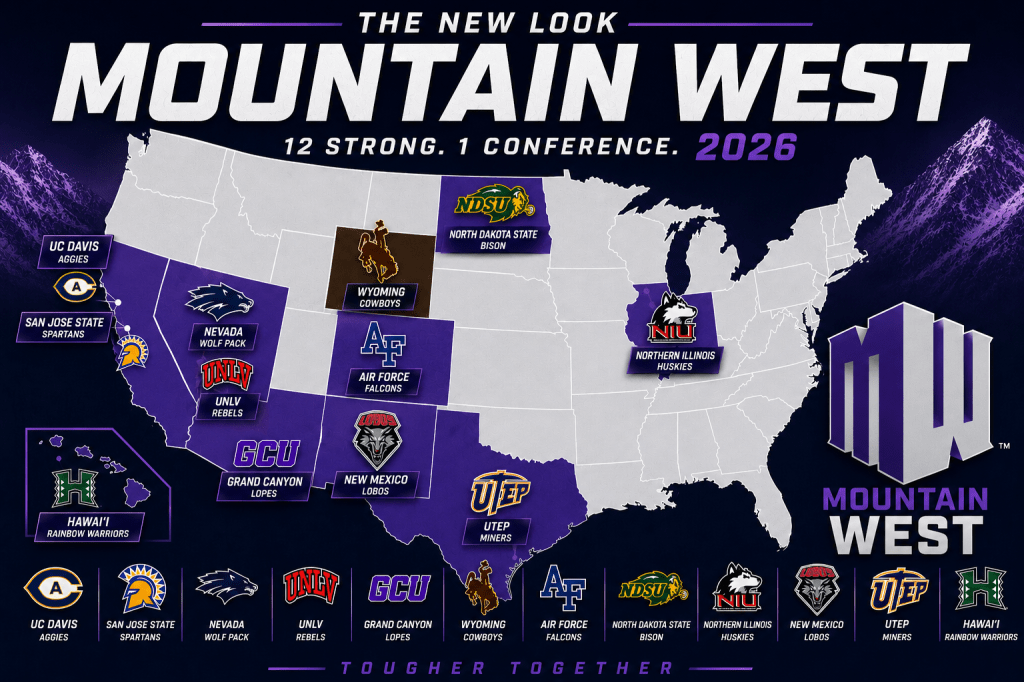
Adding schools like Grand Canyon, UC Davis, UTEP, Northern Illinois, and North Dakota State wasn’t about replacing logos. It was about building a modern conference ecosystem. And honestly; the fit makes sense.
- GCU brings one of the fastest-growing basketball brands in the country.
- UC Davis strengthens Northern Cali footprint and adds institutional credibility.
- UTEP reconnects the conference to Texas recruiting.
- Northern Illinois adds football history, Central Time Zone and Chicago land.
- North Dakota St brings one of the strongest fan bases outside the Power Four.
That’s not a desperate rebuild, that’s strategic expansion. One of the biggest criticisms surrounding the “new” Mountain West was geography.
But the conference’s footprint now feels more intentional than ever. The western foundation remains intact with:
- Nevada
- UNLV
- San José State
- Hawai‘i
- Wyoming
- New Mexico
- Air Force
Then the conference expanded into growth regions instead of random markets. Phoenix matters. Northern California matters. Texas absolutely matters and adding programs with strong local support gives the conference something every league needs right now: regional identity.
The Mountain West still feels like the Mountain West. That matters more than people think. The conference also avoided one of the biggest mistakes in modern college sports: over committing to streaming.
Instead of disappearing behind a paywall, the Mountain West built a hybrid model. That’s huge, the league now has exposure across:
- CBS
- CBS Sports Network
- FOX
- FS1 & FS2
- The CW
- streaming platforms through Kiswe
That combination gives the conference flexibility most Group of Five leagues don’t have. Linear television still matters for exposure and streaming matters for growth.
The Mountain West found a way to embrace both without sacrificing visibility and in an era where attention is currency, that balance could end up being one of the conference’s biggest advantages moving forward.
Football drives the headlines, but basketball may quietly become the Mountain West’s strongest long-term asset. Grand Canyon instantly raises the league’s basketball profile. New Mexico remains one of the best home-court environments in the country. Nevada and UNLV still carry major brand recognition. Even schools like UC Davis add depth and stability to the overall conference profile.
The NCAA Tournament matters financially and of course multiple bids matter financially. The Mountain West suddenly looks built to consistently compete for both.
Another realignment wave is coming. Everyone in college athletics knows it, but this version of the Mountain West looks far more prepared to survive it.
Why? Because the conference no longer feels fragile. It has:
- a broader geographic base,
- diversified media exposure,
- stronger basketball depth,
- growing institutional brands,
- and multiple recruiting pipelines.
More importantly, it has options.
If expansion hits again in 2030, the Mountain West isn’t sitting around hoping to survive. It’s positioned to adapt again if necessary. That’s a major difference from where the conference stood just a few years ago.
There’s a different feeling around the Mountain West now. This no longer feels like a conference waiting for another school to leave. It feels like a league building something sustainable.
No, the Mountain West isn’t going to outspend the SEC or Big Ten. That was never the goal. The goal is relevance, stability, visibility, and competitive success.
And heading into 2026, the Mountain West has a real argument that it accomplished all four. Realignment was supposed to weaken this conference. Instead, it may have forced the Mountain West to evolve into the strongest version of itself yet.


Leave a Reply